Overview
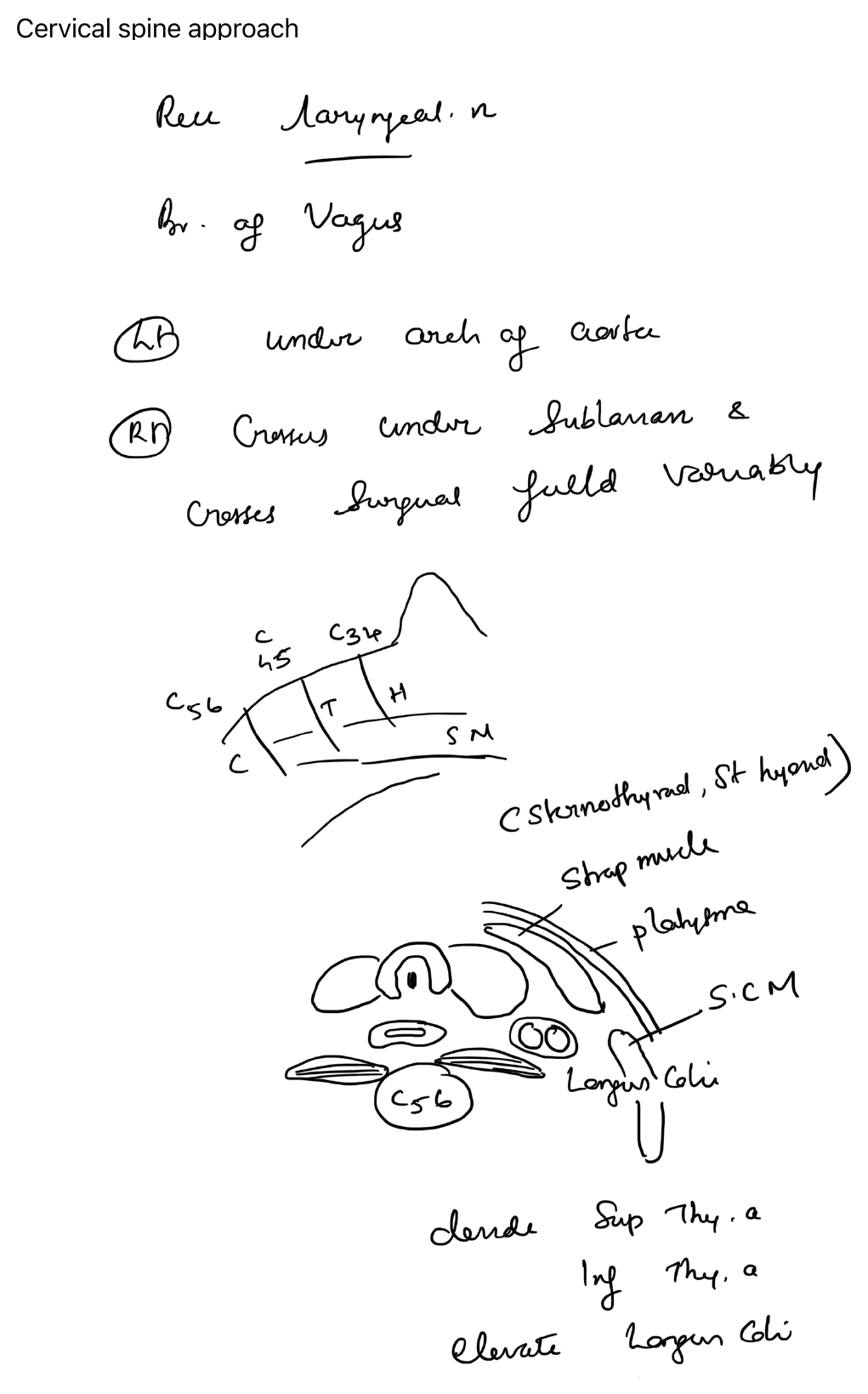
The anterior cervical approach is commonly used for cervical discectomy, corpectomy and anterior cervical fusion procedures. It provides direct access to the vertebral bodies and discs from approximately C2 to T1.
Surgical interval
The standard approach develops the interval between:
- Sternocleidomastoid / carotid sheath laterally, and
- Trachea and oesophagus medially.
The platysma is divided in line with the skin incision and the pretracheal fascia is opened to reach the anterior surface of the cervical spine.
Key structures at risk
Recurrent laryngeal nerve
- Usually ascends in the tracheo-oesophageal groove
- At risk during lower cervical exposure, particularly with retraction
- Injury causes hoarseness and vocal cord palsy
Superior laryngeal nerve
- Particularly relevant in higher exposures
- External branch is at risk around upper cervical levels and can affect phonation
Other important structures
- Oesophagus
- Trachea
- Carotid sheath contents
- Sympathetic chain
- Vertebral artery laterally in relation to the uncovertebral joints
Skin incision
- Transverse skin crease incision is commonly used for one- or two-level surgery
- Oblique or longitudinal extension may be used for multilevel exposure
- Level is confirmed with fluoroscopy before deep dissection
Deep exposure
- Retract trachea and oesophagus medially
- Retract carotid sheath laterally
- Incise prevertebral fascia
- Elevate longus colli from the vertebral bodies for placement of retractors
Side of approach
Both left- and right-sided approaches are used. A left-sided approach is often preferred by some surgeons to reduce concern regarding the more variable course of the recurrent laryngeal nerve on the right, although both are acceptable.
Complications
- Dysphagia
- Hoarseness / recurrent laryngeal nerve palsy
- Oesophageal injury
- Airway swelling or haematoma
- Carotid or vertebral artery injury
- Sympathetic chain injury causing Horner syndrome
- Dural tear or spinal cord / root injury
Diagram