Definition
Bone healing is the biological process by which bone restores continuity and strength after fracture or osteotomy. It may occur by primary (direct) bone healing or secondary (indirect) bone healing.
Primary bone healing
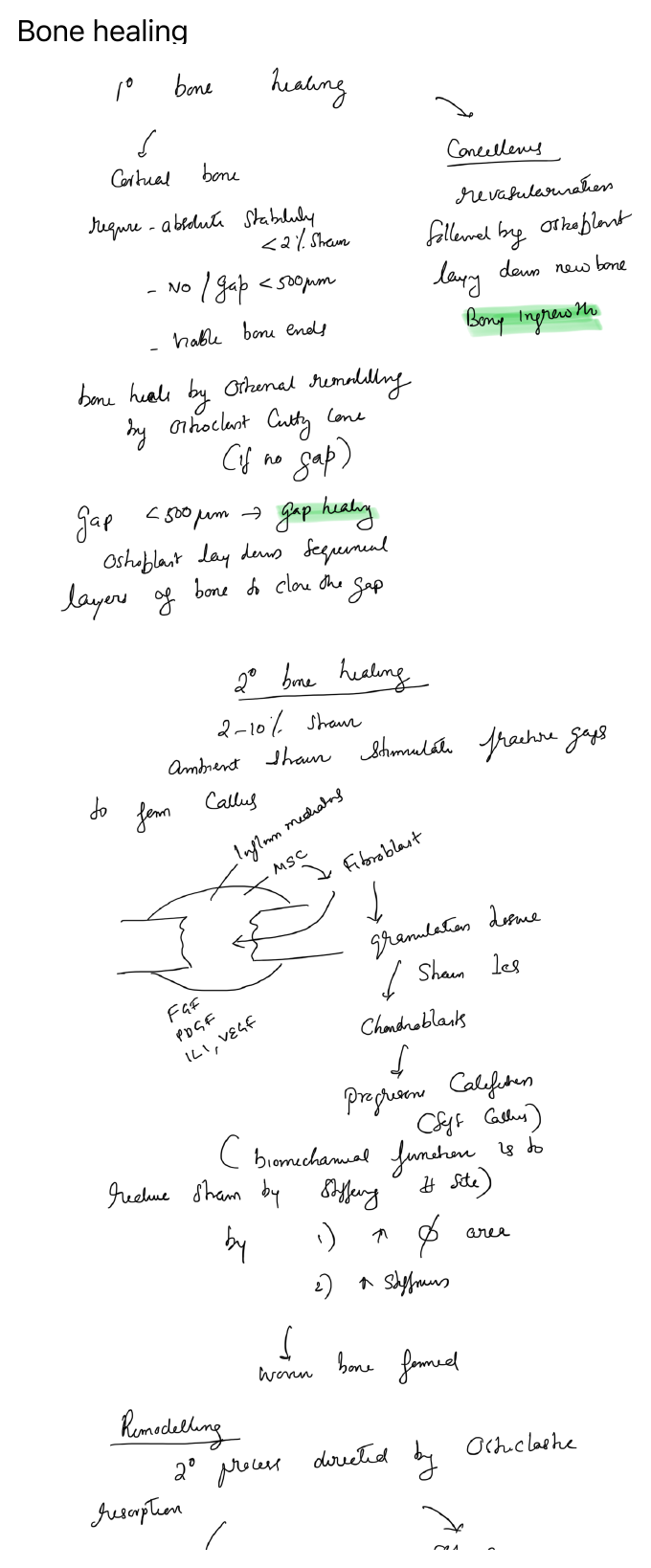
Primary bone healing occurs when there is absolute stability and very small interfragmentary strain.
Requirements
- Absolute stability, usually achieved by compression fixation
- Minimal fracture gap
- Good bone contact and viable bone ends
- Interfragmentary strain usually < 2%
Mechanism
- Contact healing occurs when there is direct osteonal remodelling across the fracture plane with little or no gap.
- Gap healing occurs when there is a small gap; the gap is first filled by lamellar bone laid perpendicular to the long axis, followed by osteonal remodelling.
- There is little or no visible callus.
Secondary bone healing
Secondary bone healing occurs when there is relative stability with some motion at the fracture site.
Usual setting
- Cast treatment
- Intramedullary nailing
- External fixation
- Bridge plating
Mechanism and stages
- Haematoma and inflammation
- Granulation tissue formation
- Soft callus with fibrocartilage
- Hard callus with woven bone
- Remodelling into lamellar bone
Biology
- Mesenchymal cells differentiate into fibroblasts, chondroblasts and osteoblasts.
- Endochondral ossification has an important role in callus formation.
- Callus increases the cross-sectional area and reduces strain at the fracture site.
Remodelling
Remodelling is the later phase in which woven bone is replaced by lamellar bone and the medullary canal is restored. It is influenced by mechanical loading and the biological environment.
Factors influencing bone healing
Mechanical factors
- Degree of stability
- Strain at the fracture site
- Gap size
- Implant choice and fixation technique
Biological factors
- Blood supply
- Soft-tissue injury
- Periosteal preservation
- Infection
- Smoking
- Malnutrition
- Diabetes and systemic illness
- Drugs such as NSAIDs in some settings
Delayed union and non-union
When healing is slower than expected, consider:
- Inadequate stability
- Excessive gap
- Poor blood supply
- Infection
- Bone loss
- Patient factors such as smoking and poor nutrition
Management should address both the mechanical problem and the biological problem.
Diagram