Clinical image
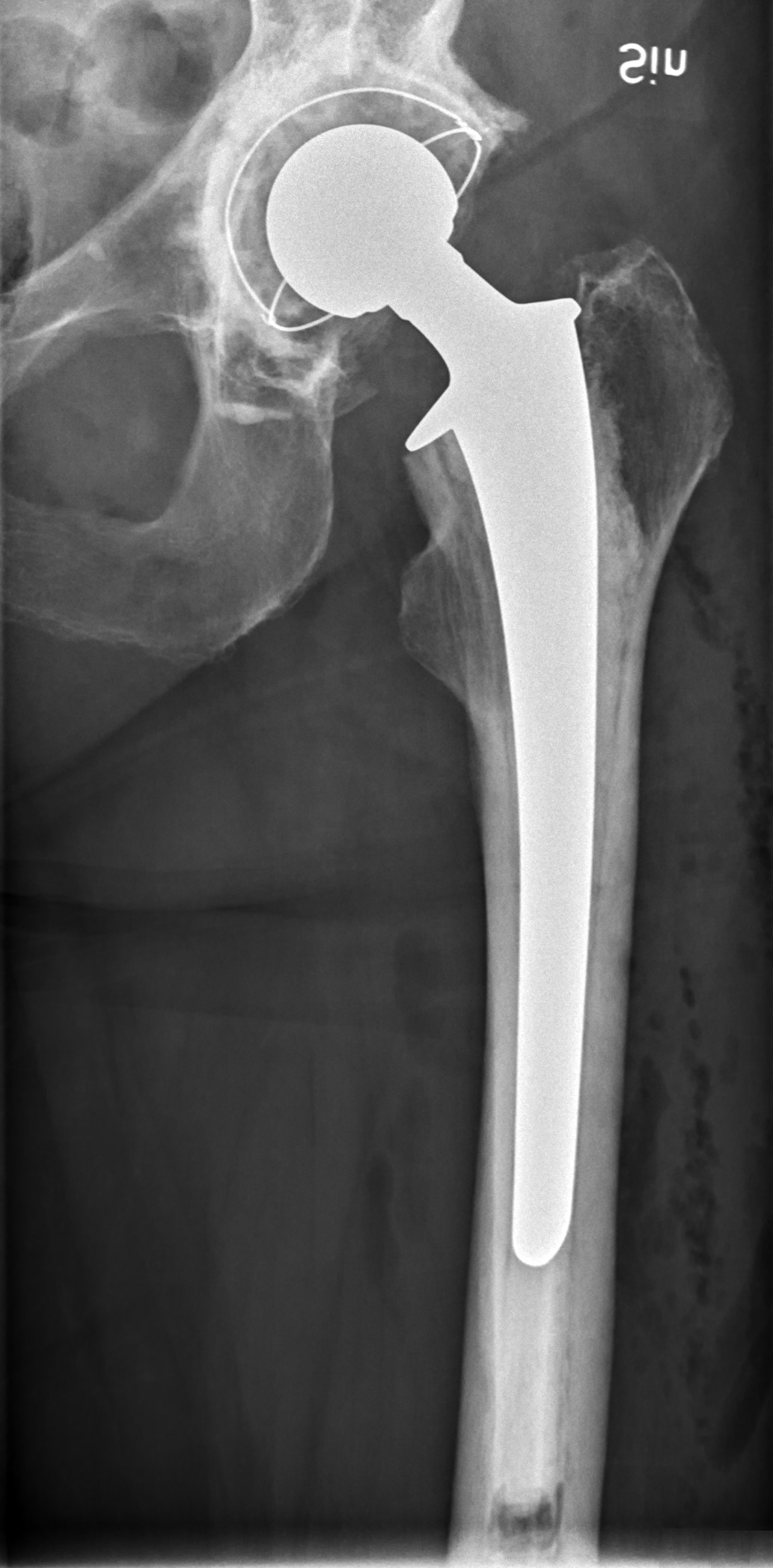
Cemented Lubinus total hip prosthesis on postoperative AP radiograph. Source: Wikimedia Commons — Mikael Häggström, M.D.; CC0 1.0. Image binary is embedded locally in this package; original source and licence are retained.

Key points
What is bone cement?
- Bone cement or Poly Methyl Meta Acrylate is a composite synthetic substance used in orthopaedics and can be described by its biomechanics and biochemical properties
- Main component is PMMA
- it is viscoelastic
- Function as grout and filler
Mechanical properties
- Good compression, moderate shear strength and poor tensile strength
- Brittle, notch sensitive (The extent to which the endurance, as determined on smooth and polished specimens, is reduced by surface discontinuities)
- Y between cortical and cancellous bone
- Viscoelastic: undergo creep, stress relaxation and hysteresis
Creep: time dependant deformation when subjected to a constant stress
- Stress relaxation: time dependant decrease in the stress required to maintain a constant strain
- Hysteresis: Loading and unloading cure will not follow the same path
What are the uses of cement
- Fixation: Grout rather than adhesive
- Fills the gap between prosthesis and bone
- Mechanical interlocking on hardening
- space filler: Non malignant lesions - osteoporotic vertebral collapse - Bone loss in revision arthroplasty - eradication of infection
Ingredients
- Liquid monomer - accelerator (N methyl toludine) and inhibitor(hydroquinone)
- powder polymer - Radi opacifier: Barium sulfate/zerconium - initiator: benzy peroxide - Abx Aminoglycoside - Dye: Chlorophyl (Palacos)
Describe the reaction
- It is a polymerisation reaction
- Exothermic, energy inefficient
- C to C double bond are broken to form C to C single bond to give long chain polymer largely liner and free of cross linking. It has low tensile strength because of the relative absence of cross linking.
Pre requisites of ABx
- Heat stable
- Polymicrobial
- long elusive period 6-8 wks
- should not create too much porosities
Stages
- curing process
- Mixing (vacuum-tensile)
- Dough time (viscosity)
- setting time
- working time
- Hardening phase : after working phase 24 hrs
Key points
Stages
- only constant is mixing time
- other phases depend on temperature, handling and mixing
- increased humidity increases doughy phase
Complications
- Bone cement implant syndrome
- Thermal necrosis
- Chemical necrosis
- third body wear
- cement mantle defect
- hypersensitivity reaction
Mandle defect
- Barrack and harris
- A white out
- B radiolucency <50%
- C > 50%
- D 100% or no cement at tip
cementing techniques
- 1st gen: hand mix, finger pack
- 2 nd gen: gun, plug, canal preparation
- 3rd gen: vacuum mix, pulse lavage and distal centraliser and pressurisation
- 4th gen: proximal centraliser
cement of your choice
- Which viscosity
- coloured
- Gentamycin
- Zirconium/barium sulphate
- Sterilised using ethylene oxide
- NJR data, THR/TKR revision 10 y <4
- May contain traces of peanut oil
Bone cement implant syndrome
- Occurs at time of implantation
- characterised by hypotension, hypoxia, cardiac arrhythmia, cardiac arrest
- Causes are thought to be exothermic reaction, air/fat embolism or toxic hypersensitivity/ anaphylaxis
- Prevention: Anaesthetist: oxygen, fluid, surgeon: Pulse lavage, brushing medullary canal, mix in vacuum, venting femur, retrograde cementing with gun
Recommendations
- There should be a three-stage process to reduce the incidence of problems in patients undergoing cemented hemiarthroplasty for hip fracture:
- Identification of patients at high risk of cardiorespiratory compromise:
- a) Increasing age;
- b) Significant cardiopulmonary disease;
- c) Diuretics;
- d) Male sex.
- Preparation of team(s) and identification of roles in case of severe reaction:
- a) Pre-operative multidisciplinary discussion when appropriate;
- b) Pre-list briefing and World Health Organization Safe Surgery checklist ‘time-out’.
3.Specific intraoperative
- Surgeon:
- Inform the anaesthetist that you are about to insert cement;
- Thoroughly wash and dry the femoral canal;
- Apply cement in retrograde fashion using the cement gun with a suction catheter and intramedullary plug in the femoral shaft;
- Avoid vigorous pressurisation of cement in patients judged to be at risk of cardio- vascular compromise (see below).
- Anaesthetist:
- Ensure adequate resuscitation pre- and intra-operatively;
- Confirm to surgeon that you are aware that he/she is about to prepare/apply cement;
- Maintain vigilance for signs of cardiorespiratory compromise.
- Fall in syt BP may be first sign
- Aim for a systolic blood pressure within 20% of pre-induction value;
- Prepare vasopressors in case of cardiovascular collapse
Key points
- Gypsum plaster, or plaster of Paris, is produced by heating gypsum to about 300 °F (150 °C):[14]
- CaSO4·2H2O + heat → CaSO4·0.5H2O + 1.5H2O (released as steam).
- When the dry plaster powder is mixed with water, it re-forms into gypsum. The setting of unmodified plaster starts about 10 minutes after mixing and is complete in about 45 minutes; but not fully set for 72 hours.If plaster or gypsum is heated above 266 °F (130 °C), hemihydrate is formed, which will also re-form as gypsum if mixed with water.