Primary and secondary healing
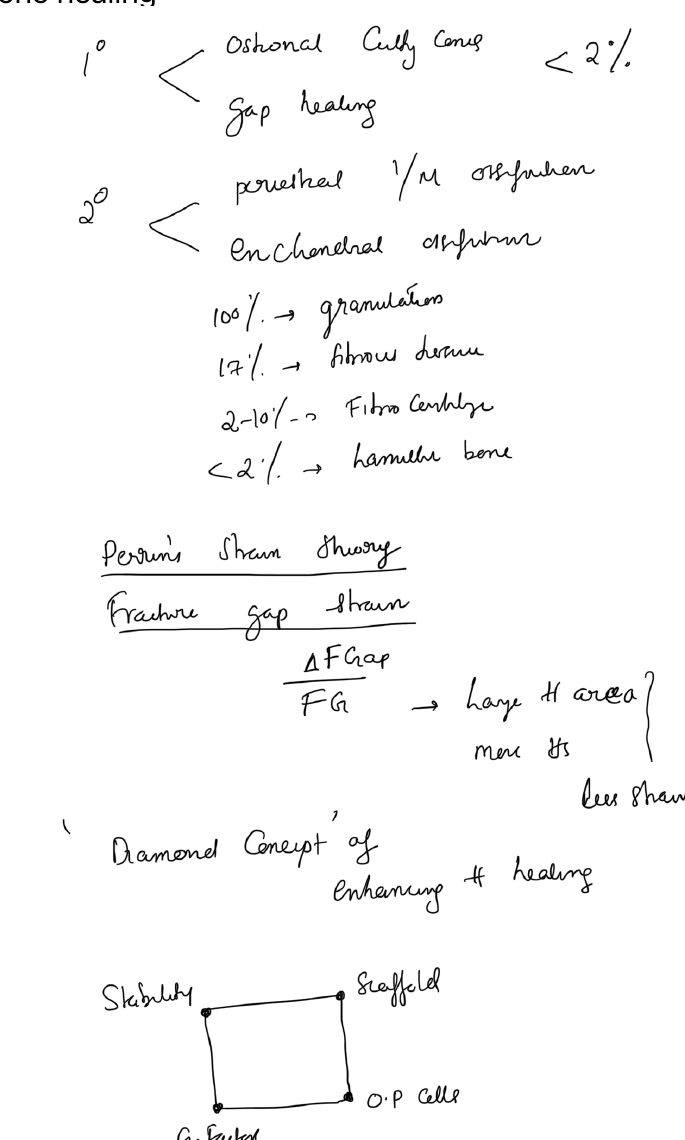
Bone healing occurs through primary (direct) or secondary (indirect) mechanisms depending principally on stability and interfragmentary strain.
Primary healing
Requires absolute stability and very low strain.
- Contact healing: osteonal remodelling crosses the fracture line directly.
- Gap healing: a small gap is filled by bone before osteonal remodelling.
- Little or no callus is produced.
Secondary healing
Occurs with relative stability and proceeds through:
- inflammation and haematoma
- granulation tissue
- soft callus
- hard callus / woven bone
- remodelling into lamellar bone
Interfragmentary strain
Strain is the change in fracture-gap length divided by the original gap length.
Different tissues tolerate different levels of strain. As callus increases the cross-sectional area and stiffness of the healing region, local strain falls and progressively more rigid tissue can form.
Mechanical environment
- Absolute stability favours direct healing.
- Relative stability favours callus formation.
- Excessive motion prevents progression to bone formation and may contribute to non-union.
Diamond concept
Successful fracture healing depends on the interaction of:
- mechanical stability
- osteogenic cells
- osteoconductive scaffold
- osteoinductive signals
- adequate vascularity / host environment
Bone graft incorporation
Graft incorporation proceeds through inflammation, vascular ingrowth, osteogenic activity, osteoinduction, osteoconduction and remodelling. The relative contribution depends on graft type.