Clinical image
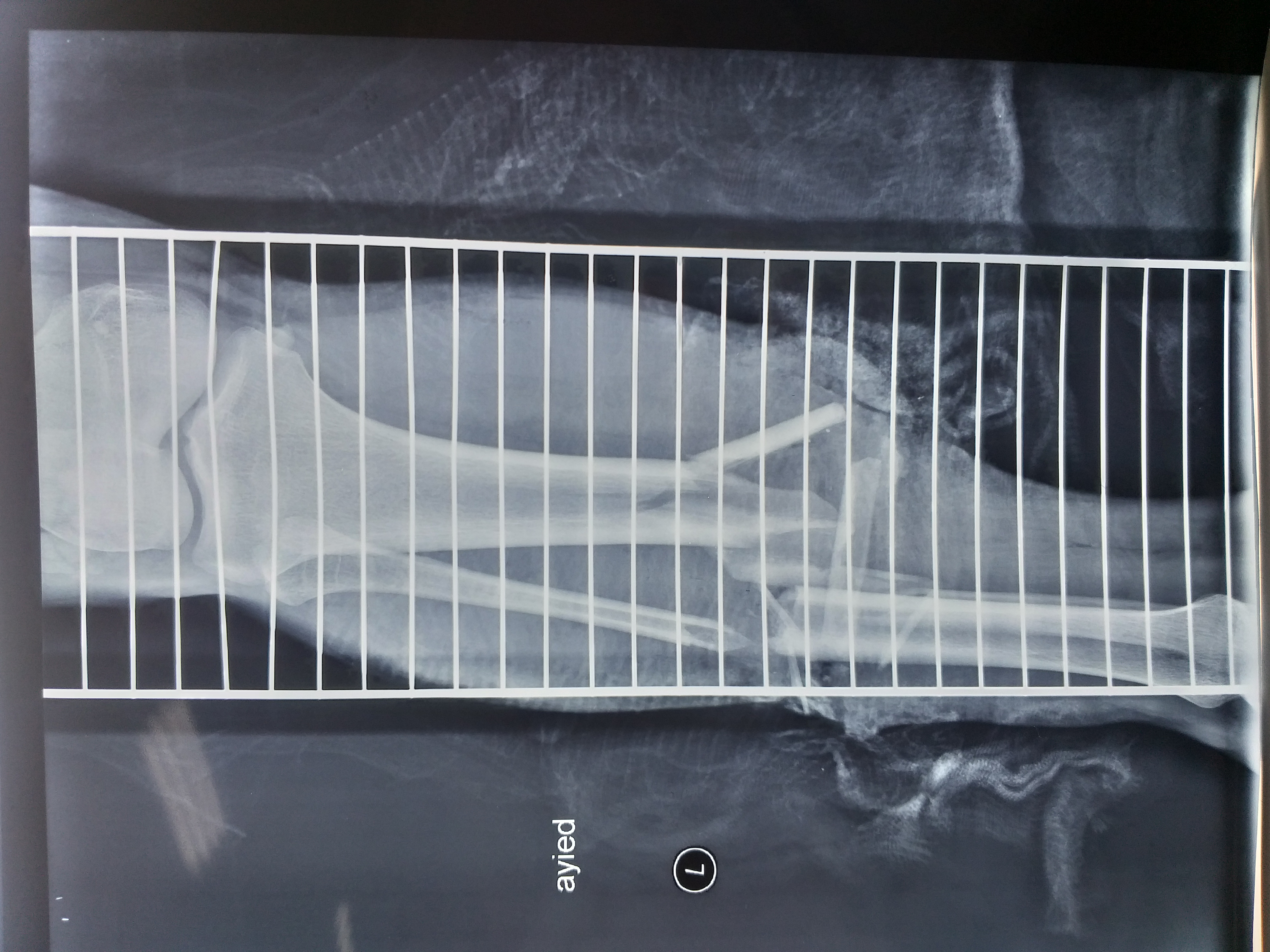
Clinical photograph of an open tibial and fibular shaft fracture. Source: Wikimedia Commons — MustafaSalahalden; CC BY-SA 4.0. Image binary is embedded locally in this package; original source and licence are retained.

Principles
- Initial approach will be along ATLS protocol
- Assuming that the injury is isolated, I will follow the BOAST 4 guideline
- I will follow a MDT approach involving ortho plastic care
- Because the consequences of infection can be great both for the community and the individual patient
Principles based on BOAST 4
- Initial management
- Ward management: Timing of Debridement
- immediate: High contamination/asso V/C
- <12hr: solitary high energy open fracture
- <24 hrs: all other low energy open fracture
- Theatre management
- Post op management
Initial management
- Antibiotic with in 1hr of injury
- examine for NV injury and compartment syndrome
- Realign and splint and repeat examination of NVC
- Repeat examination
- Minimum handling of wound
  - Remove gross contamination
  - Saline soaked dressing covered with occlusive film
- Photographs: first seen, after debridement , every key stages
- CT: scanogram head to toe, angiogram if arterial injury suspected
Initial Antibiotic
- IV antibiotic with in 1 hour of injury
- Gustilo Type I and II
- 1st generation cephalosporin (clindamycin or vancomycin can also be used if allergic)
- Gustilo Type III
- 1st generation cephalosporin + aminoglycoside
- Farm injuries, heavy contamination, or possible bowel contamination
- add high dose penicillin for anaerobic coverage (clostridium)
- Special considerations
- fresh water wounds
- fluoroquinolones or 3rd or 4th generation cephalosporin
- saltwater wounds
- doxycycline + ceftazidime or a fluoroquinolone
- fresh water wounds
- Duration
- continue for 24 hours after initial injury if wound is able to be closed primarily
- continue for 24 hours after final closure if wound is not closed during initial surgical debridement (72 hours for Type III wounds)
Theatre management
- Combined Orthoplastic approach
- Debridement with wound extended through fasciotomy lines
- Any further procedure is considered a clean surgery
- Internal Fixation only if definitive wound cover possible immediately
- MDT assessment if decision on limb salvage/amputation planned
Debridement
- Remove all contamination
- Low pressure pulse lavage
- Remove dead and devitalised tissue
- Dead muscle is identified by color, consistency, contractility and ability to bleed
- Remove all loose bone , pull test
Post op management
- Information regarding
  - expected function,
  - rehabilitation,
  - when to return to work and driving
Mangled Extremity Severity Score (MESS)
| Column 1 |
|---|
| Introduction; used to predict necessity of amputation after lower extremity trauma; Variables; skeletal and soft tissue injury (graded 1-4); limb ischemia (graded 1-3); shock (graded 0-2); age (graded 0-2); Calculation; score determined by adding scores of components in four categories ; Interpretation; score of >7 is predictive of amputation; Pros; high specificity for predicting amputation; Cons; low sensitivity for predicting amputation |
score of five in functional units
- a score of five in any of two components
15 points
Key points
| Column 1 |
|---|
| Oestern and Tscherne classification of soft tissue injury in closed fractures |
| Column 1 | Column 2 |
|---|---|
| Grade 0 | Minimal soft tissue damage; indirect injury to limb (torsion); simple fracture pattern |
| Grade 1 | Superficial abrasion or contusion; mild fracture pattern |
| Grade 2 | Deep abrasion; skin or muscle contusion; severe fracture pattern; direct trauma to limb |
| Grade 3 | Extensive skin contusion or crush injury; severe damage to underlying muscle; compartment syndrome; subcutaneous avulsion |
Compartment Syndrome
Principles
with significant limb injuries,
after surgery for limb injuries, and
after any prolonged surgical procedure which may result in hypoperfusion of a limb.
I will suspect CS in the following situations
I will follow BOAST 10 guideline and My first priority is clear documentation of
Time and MOI
Time of evaluation
Level of pain and consciousness
Response to analgesia
whether regional analgesia was given or not
Initial evaluation
Initial management
Ward management
Theatre management
My initial evaluation involves
- Looking for pain out of proportion to the associated injury
- Pain on passive movement of the muscles of involved compartment
- Record Limb Neuro vascular status, but donot contribute to initial diagnosis
Initial management
- Avoid regional anaesthesia
- Rate and dose of Patient controlled analgesia recorded
- Release all circumferential dressing
- Elevate limb to heart level
- Maintain normal BP
- re evaluate in 30 min
- Measure compartment pressure when in doubt/unconscious patient
- Record all actions
Ward management
- At risk limb should have hourly limb observations of early signs
- When pain scores not reducing, a senior clinical review is needed
Theatre management
- Surgery should be done with in 1 hour of decision to operate
- Open fascial decompression of all involved compartments
- Necrotic muscle excised
- Document the procedure
- Re explore in 48 hours
- Early involvement of plastic
- Follow BOAST 4 guideline for leg compartment (2 incision )
- No consensus for foot compartment
- Late presentation/diagnosis should involve 2 consultants. non operative is an option
Compartment pressure
- Measure diastolic pressure and compartment pressure
- If difference is <30mmHg
- or Absolute pressure >40mmHg
- If so urgent surgical decompression
Key points
- Acute compartment syndrome of a limb is due to raised pressure within a closed fascial compartment causing local tissue ischaemia and hypoxia.
- In clinical practice, it is most often seen after tibial and forearm fractures, high-energy wrist fractures and crush injuries.
- Other important causes include restrictive dressings or casts, prolonged immobilization and reperfusion of ischaemic limbs.
- Early diagnosis and treatment is vital to avoid severe disability.
- Pulses are normally present in compartment syndrome. Absent pulses are usually due to systemic hypotension, arterial occlusion or vascular injury.
Arterial injuries
I will approach the patient based on ATLS protocol
- Life threatening injuries are given priority
- Assuming an isolated injury, I will follow the BOAST 6 guideline
Principles
- Initial Management
- Theatre management
- Post operative management
Initial management
- Active haemorrhage should be controlled by direct pressure or tourniquet
- An injured limb should be considered to have NV injury unless definitely excluded and documented
- Realign and reduce any dislocation and splint
- Repeat NV examination
- I will look for following clinical signs: altered sensation, expanding haematoma, absent pulses, pink pulselessness
Theatre management
- Urgent exploration with in 3-4 hrs of injury
- Only delay should be due to treating life threatening injuries
- Hight risk of amputation should be informed to the patient
- A decision to amputation taken by 2 consultants
- Vascular and orthopaedic teams should cooperate
- Duplex, ct angiogram and on table angiogram assess must not delay repercussion injury as injury pattern predicts the level
- Sequence: temporary shunt, assess viability, skeletal stabilisation, finally definite reconstruction
- Incisions should preserve perforators
Post operative management
- Post-operative care should be provided in an appropriate area with nursing and medical staff competent in the as- sessment of the critically injured limb.