Standard medial parapatellar approach
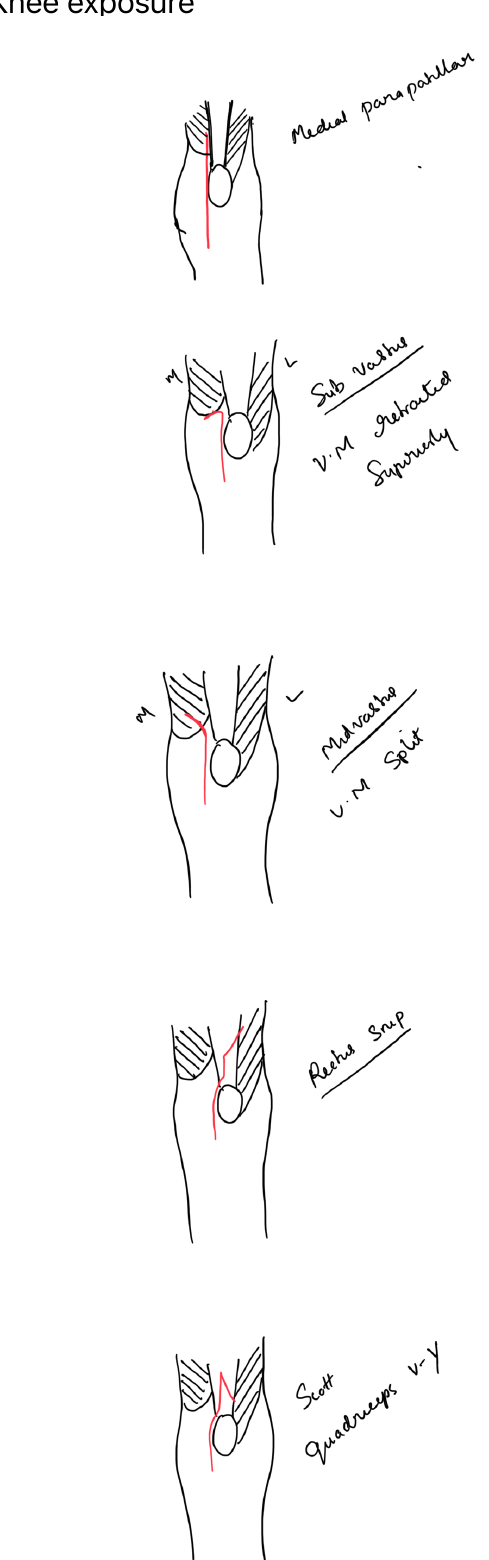
The medial parapatellar approach is the most widely used exposure for total knee arthroplasty and provides reliable access to the anterior knee.
A midline skin incision is followed by a medial parapatellar arthrotomy extending through the quadriceps tendon proximally and along the medial border of the patella and patellar tendon distally.
Midvastus approach
The proximal arthrotomy extends into the vastus medialis rather than through the quadriceps tendon.
Advantages:
- preserves the quadriceps tendon
- may reduce early extensor mechanism disruption
Limitations:
- less extensile than the standard medial parapatellar approach
- difficult exposure in obese or very stiff knees
- potential partial denervation of vastus medialis
Subvastus approach
The vastus medialis is elevated from the intermuscular septum without splitting the muscle or quadriceps tendon.
Advantages:
- preserves the extensor mechanism
- preserves medial patellar vascularity
Limitations:
- least extensile of the common approaches
- difficult in obese, muscular or very stiff knees
- less suitable for revision surgery
Lateral parapatellar approach
Useful in selected fixed valgus knees because it provides direct access to the contracted lateral structures and preserves the medial blood supply of the patella.
Extensile exposure
When standard exposure is inadequate, options include:
Quadriceps snip
A proximal oblique extension of the medial parapatellar arthrotomy into the vastus lateralis. It increases exposure without requiring major change in postoperative rehabilitation.
V–Y quadriceps turndown
Provides greater exposure and allows quadriceps lengthening but may produce extensor lag and requires protection postoperatively.
Tibial tubercle osteotomy
Useful in difficult primary or revision cases when patellar eversion remains unsafe. The osteotomy must be securely repaired and protected until union.
Skin-incision principles
When previous incisions are present:
- plan the incision carefully to preserve skin vascularity
- if choosing between longitudinal scars, the more lateral scar is often preferred because anterior skin blood supply is predominantly medial
- transverse scars may generally be crossed at approximately right angles
- avoid creating a narrow compromised skin bridge
References
- Orthobullets. TKA Approaches.
- Orthobullets. Knee Medial Parapatellar Approach.