Definition
The standard error of the mean (SEM) estimates the precision with which a sample mean represents the population mean.
Formula
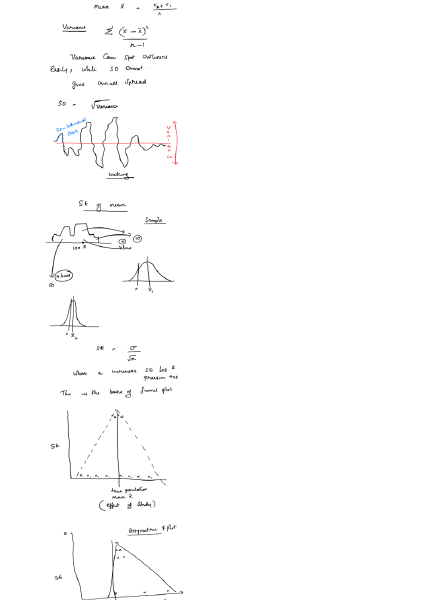
SEM = SD / √n
where:
- SD = sample standard deviation
- n = sample size
As sample size increases, SEM decreases.
Standard deviation versus standard error
- Standard deviation describes the spread of observations within a sample.
- Standard error describes the uncertainty or precision of an estimate, such as the sample mean.
They should not be used interchangeably.
Confidence interval
For a sufficiently large sample with approximately normal sampling behaviour, an approximate 95% confidence interval for the mean is:
mean ± 1.96 × SEM
For smaller samples, the appropriate t distribution is used rather than simply 1.96.
Central limit theorem
As sample size increases, the sampling distribution of the mean approaches a normal distribution under broad conditions, even when the underlying population is not perfectly normal.
Clinical interpretation
A small SEM indicates that the sample mean is estimated precisely. It does not mean that individual observations are tightly clustered; that is described by the SD.
Common error
When describing variability among individual patients, report SD rather than SEM. SEM or confidence intervals are used when the purpose is to describe precision of an estimated mean.