Skeletal muscle uses several energy systems simultaneously. The relative contribution of each system changes with exercise intensity and duration.
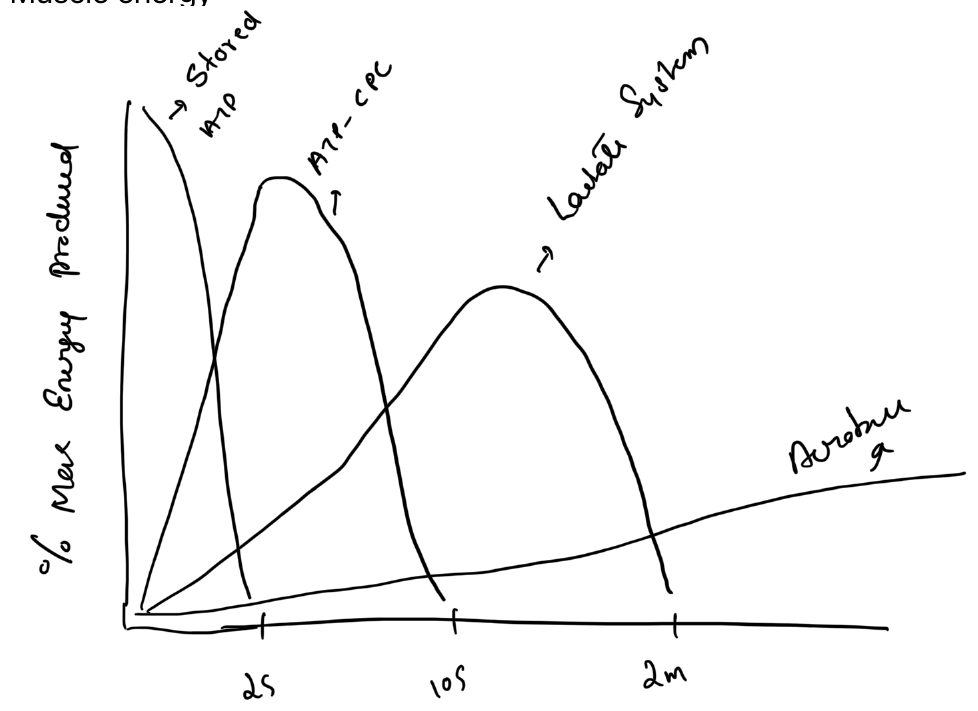
Stored ATP
A small amount of ATP is already present within muscle and supplies energy immediately when contraction begins. The store is very limited and is sufficient for only the first few seconds of maximal activity.
ATP–phosphocreatine system
The phosphagen system rapidly regenerates ATP from phosphocreatine:
Phosphocreatine + ADP → creatine + ATP
Features:
- Anaerobic
- Does not generate lactate directly
- Very high power output
- Low capacity
- Dominant during brief maximal efforts, particularly the first approximately 10 seconds; it remains important during intense activity lasting up to about 20 seconds
Typical example: short sprint, jump or maximal lift.
Anaerobic glycolysis
Glucose or glycogen is metabolised rapidly without reliance on oxidative phosphorylation.
Features:
- High rate of ATP production
- Lower power than the phosphagen system but greater capacity
- Becomes important during intense exercise lasting roughly 20–120 seconds
- Associated with lactate production
Typical example: a 400-m sprint or repeated high-intensity effort.
Aerobic oxidative system
ATP is generated predominantly by oxidative phosphorylation using carbohydrate and fatty acids.
Features:
- Requires oxygen
- Slower rate of ATP production
- Very large capacity
- Increasing contribution as exercise duration increases
- Dominant during prolonged, lower-intensity activity
Typical example: distance running or sustained endurance activity.
Relative contribution with time
The systems overlap rather than switching on and off abruptly:
- First seconds: stored ATP and phosphocreatine predominate
- Seconds to about 2 minutes: anaerobic glycolysis makes a major contribution
- Beyond about 2 minutes: oxidative metabolism increasingly dominates
The exact contribution depends on exercise intensity, training status, muscle fibre recruitment and substrate availability.
Muscle fibre relationship
Type I fibres are slow-twitch, oxidative fibres with high mitochondrial density and fatigue resistance. They are suited to endurance activity.
Type II fibres generate force rapidly and have greater reliance on phosphagen and glycolytic metabolism. They are suited to short, high-intensity activity but fatigue more quickly.