Functions of a plate
A plate may function as:
- compression plate
- neutralisation / protection plate
- buttress plate
- tension-band plate
- bridge plate
The mechanical function of the plate should match the fracture pattern and the desired mode of healing.
Compression plating
Compression plating produces absolute stability and promotes primary bone healing.
Compression may be achieved by:
- lag screw compression with a neutralisation plate
- eccentric screw placement in dynamic compression holes
- pre-bending the plate for transverse fractures
- compression devices in selected constructs
Dynamic compression holes convert eccentric screw insertion into axial movement of the bone fragment toward the fracture.
Neutralisation plate
A neutralisation plate protects interfragmentary lag screws from bending, torsional and shear forces while the lag screws provide compression across the fracture.
Buttress plate
A buttress plate resists axial collapse and shear of a periarticular fragment. It is placed where the fragment tends to displace under load.
Bridge plating
Bridge plating spans a comminuted fracture zone while preserving length, alignment and rotation.
- provides relative stability
- preserves fracture biology by limiting soft-tissue stripping
- allows callus formation
- plate working length and screw distribution determine construct stiffness
Tension-band principle
A plate placed on the tension side of a bone converts tensile forces into compression at the opposite cortex during loading.
Locking plates
In a locking construct the screw locks into the plate, creating a fixed-angle device.
Advantages include:
- improved fixation in osteoporotic bone
- useful fixation in short periarticular segments
- less dependence on plate-to-bone friction
- suitability for minimally invasive bridge plating
Plate biomechanics
Working length
The working length is the distance between the screws closest to the fracture on either side.
- shorter working length → stiffer construct
- longer working length → more flexible construct
Plate thickness
Bending rigidity increases markedly with plate thickness and is proportional approximately to the third power of thickness.
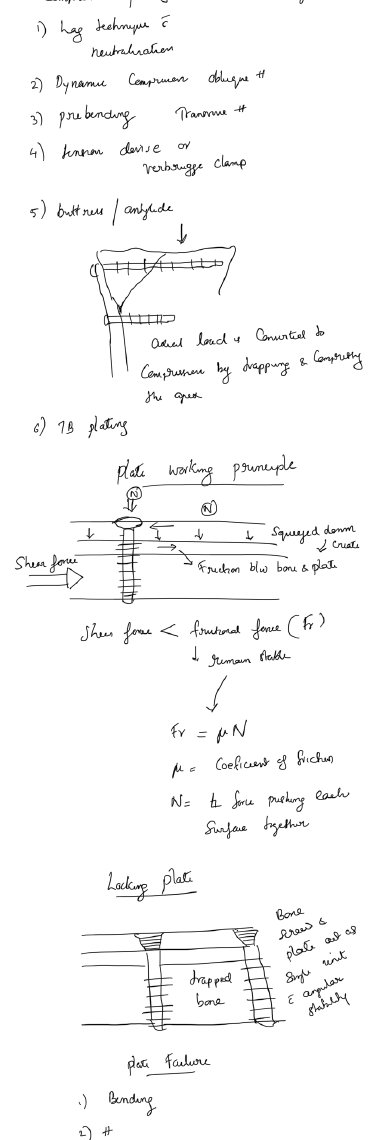
Common modes of failure
- plate bending
- plate breakage
- screw pull-out
- screw breakage
- loss of reduction
- non-union with fatigue failure of the implant
References
- Orthobullets. Orthopaedic Implants — Basic Science.