Purpose
Waddell signs are a group of non-organic physical signs described in patients with low back pain. They are not a test for malingering. Rather, they suggest that behavioural, psychological or non-structural factors may be contributing to the pain presentation.
Components
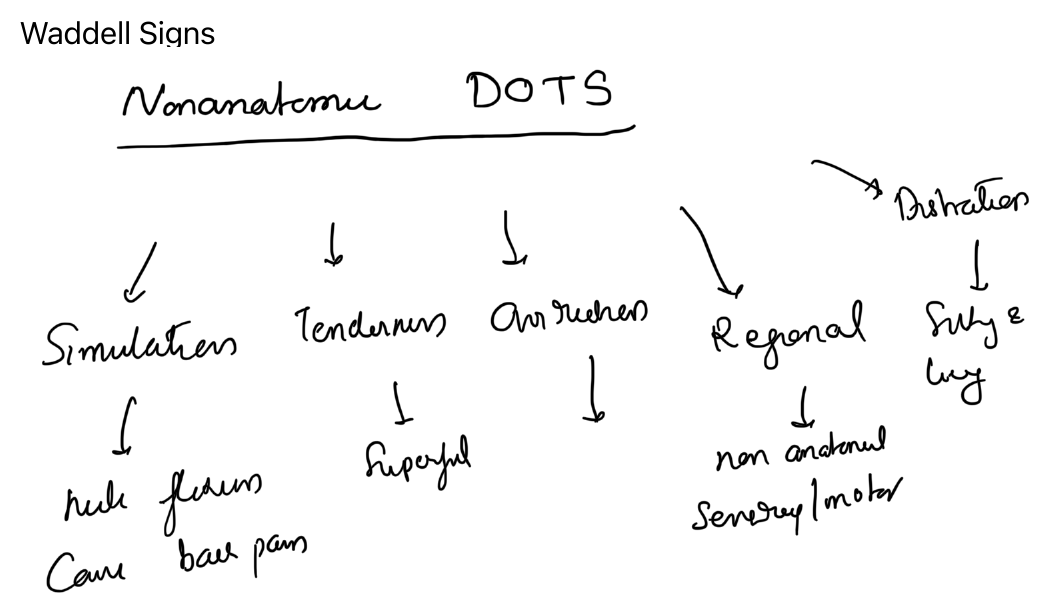
The signs are classically grouped into five categories.
1. Tenderness
- Superficial tenderness over a wide area of skin
- Non-anatomic tenderness that is deep and widespread, not localised to one structure
2. Simulation tests
These manoeuvres reproduce pain without stressing the relevant anatomical structure.
- Axial loading on the skull producing low back pain
- Simulated rotation of the shoulders and pelvis together producing low back pain
3. Distraction tests
A positive finding on a formal test is absent when the patient is distracted.
- The classic example is straight-leg raising being limited during formal examination but improving when the patient is distracted, such as while sitting.
4. Regional disturbances
- Regional weakness not fitting a neuroanatomical pattern
- Regional sensory change not fitting a dermatomal pattern
5. Overreaction
- Disproportionate verbalisation, facial expression, muscle tension or collapse during examination
Interpretation
- The presence of three or more categories is usually considered a positive test.
- Positive Waddell signs do not exclude organic pathology.
- They should prompt a broader assessment of pain behaviour, psychosocial factors and functional disability.
- They are not, on their own, evidence of exaggeration or secondary gain.
Clinical use
Waddell signs may be relevant in chronic low back pain, especially when the severity of observed disability is out of proportion to the structural findings.
Diagram