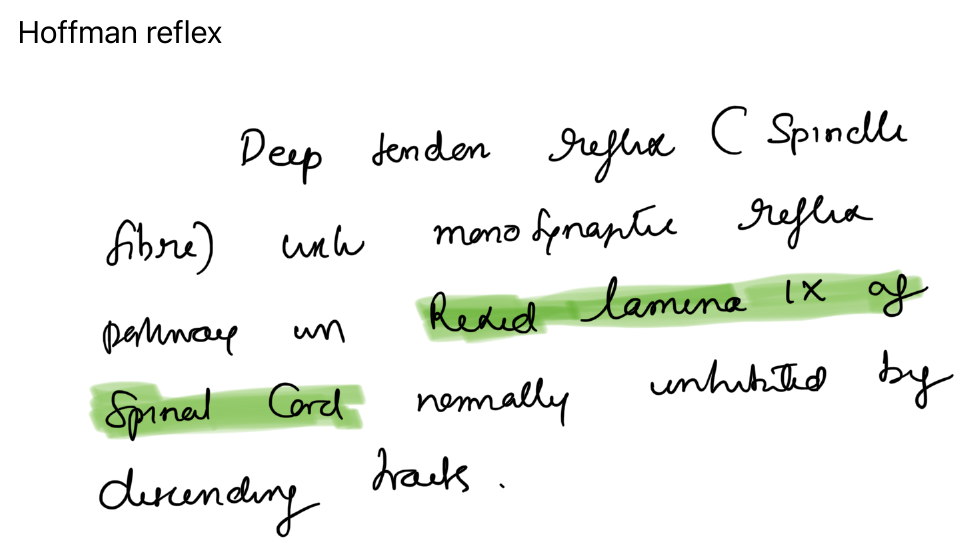
Definition
The Hoffman sign is a pathological reflex that suggests corticospinal tract dysfunction, usually due to an upper motor neurone lesion affecting the cervical cord or brain.
How to test
- Hold the patient’s middle finger loosely
- Flick or snap the distal phalanx / nail downward
- Observe the thumb and index finger
A positive sign is reflex flexion / adduction of the thumb with flexion of the index finger.
Mechanism
The sign reflects hyperexcitability of the reflex pathways due to loss of descending inhibition. It is analogous to an upper-limb plantar-type pyramidal sign.
Clinical significance
A positive Hoffman sign may be seen in:
- Cervical myelopathy
- Multiple sclerosis
- Other causes of corticospinal tract disease
- Some normal individuals with brisk reflexes
It should therefore be interpreted in the full clinical context.
Associated findings in cervical myelopathy
- Hand clumsiness
- Gait disturbance
- Hyperreflexia
- Spasticity
- Inverted supinator reflex
- Plantar extensor response
Limitations
A positive Hoffman sign is not diagnostic on its own. It is supportive of an upper motor neurone lesion but must be correlated with other clinical findings and imaging.
Diagram