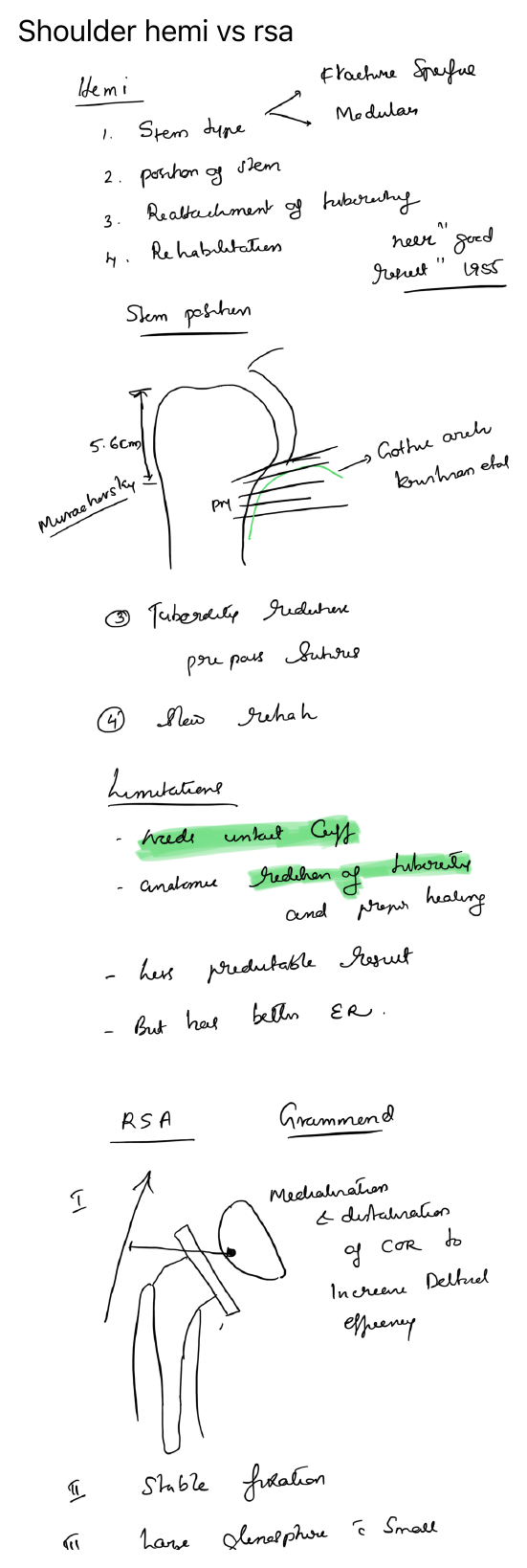
Hemiarthroplasty
Shoulder hemiarthroplasty replaces the humeral head while retaining the native glenoid.
Potential indications
- selected proximal humeral fractures in younger patients when tuberosity healing and rotator cuff function are expected
- osteonecrosis with preserved glenoid in selected cases
- situations where glenoid replacement is undesirable or not possible
Dependence on tuberosities and cuff
Functional outcome after fracture hemiarthroplasty depends heavily on tuberosity healing and a functioning rotator cuff.
Reverse shoulder arthroplasty
Reverse arthroplasty medialises and lowers the centre of rotation so the deltoid can elevate the arm despite deficient cuff function.
Common indications
- cuff-tear arthropathy
- pseudoparalysis with irreparable cuff deficiency
- selected complex proximal humeral fractures, especially in older patients
- failed previous shoulder arthroplasty
Fracture comparison
In an older patient with a complex three- or four-part proximal humeral fracture and poor bone or tuberosity quality, reverse shoulder arthroplasty is frequently preferred because function is less dependent on tuberosity healing than hemiarthroplasty.
Hemiarthroplasty remains relevant in carefully selected patients where cuff and tuberosity function can be restored and glenoid replacement is not required.
Diagram