Definition
Leg length discrepancy (LLD) is a difference in the lengths of the lower limbs. It may be true or apparent, and may be static or progressive.
Causes
Congenital
- proximal femoral focal deficiency
- hemihypertrophy or hemiatrophy
- congenital limb deficiency
- developmental dysplasia of the hip
Acquired
- physeal injury or infection
- malunion
- avascular necrosis
- tumour or tumour treatment
- neuromuscular disease
Clinical assessment
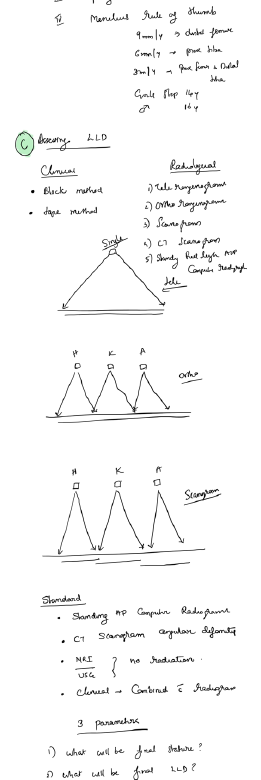
Block test
With the child standing, blocks are placed under the short limb until the pelvis is level. The total block height estimates the discrepancy and is the best simple screening test.
Tape measurement
True length is commonly measured from the ASIS to the medial malleolus. Apparent length is affected by pelvic obliquity and joint contractures.
Always assess:
- hip, knee and ankle contractures
- pelvic obliquity
- angular deformity
- gait
Imaging
- standing long-leg radiograph / scanogram
- teleoroentgenogram
- CT scanogram when contracture makes conventional radiographic measurement unreliable
- bone-age radiograph when growth prediction is required
Predicting discrepancy at maturity
Methods include:
- Green–Anderson growth-remaining charts
- Moseley straight-line graph
- Multiplier method
The multiplier method is particularly useful for congenital discrepancy. Prediction should use skeletal maturity rather than chronological age alone whenever possible.
Principles of treatment
Treatment is based on the predicted discrepancy at skeletal maturity, the cause, remaining growth and patient factors.
- < 2 cm — observation or shoe lift is usually sufficient
- > 2 cm — operative treatment may be considered depending on predicted final discrepancy and growth remaining
- epiphysiodesis is used to slow growth of the longer limb in a growing child
- limb lengthening is used for larger discrepancies when preservation of overall height and limb length is important
- shortening procedures may be considered in selected skeletally mature patients
Epiphysiodesis
Timing is critical. The procedure may involve:
- distal femur
- proximal tibia
- both distal femur and proximal tibia
Accurate prediction of remaining growth is essential to avoid under- or over-correction.
Lengthening
Distraction osteogenesis usually follows a latency period after corticotomy and gradual distraction of approximately 1 mm/day, adjusted according to regenerate quality and soft-tissue tolerance.
Complications of treatment
- residual discrepancy
- angular deformity
- joint stiffness or subluxation
- pin-site infection
- fracture
- delayed regenerate formation
- neurovascular or soft-tissue complications
References
- Orthobullets. Leg Length Discrepancy (LLD).
- Paley / multiplier-method literature for prediction of limb-length discrepancy at maturity.