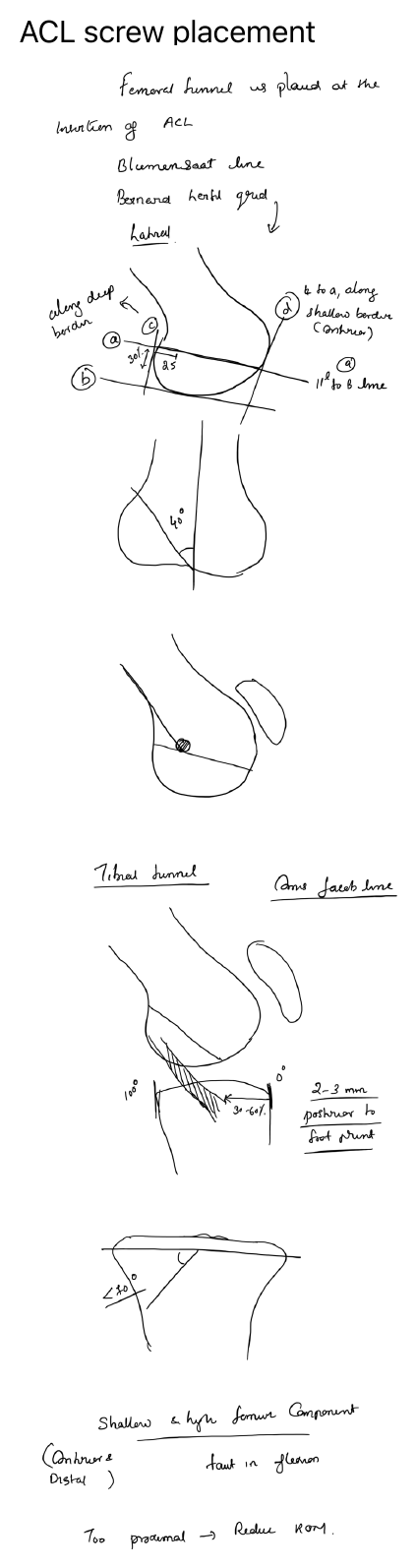
Purpose
Interference screw placement in ACL reconstruction secures the graft within the femoral and tibial tunnels and promotes graft incorporation.
Principles
- The screw should sit parallel or nearly parallel to the graft.
- Adequate tunnel position is more important than the screw itself.
- Screw size should match tunnel diameter and graft bulk.
- Fixation must avoid graft laceration and tunnel blow-out.
Femoral side
- Fixation may be by interference screw or suspensory fixation depending on technique.
- When a femoral interference screw is used, the graft should be tensioned and the screw inserted along the tunnel while maintaining graft position.
- Screw divergence reduces fixation strength.
Tibial side
- Tibial fixation is commonly with an interference screw, often supplemented by a post, staple or backup fixation in soft-tissue grafts.
- Fix the knee in the chosen degree of flexion while maintaining appropriate graft tension.
Pitfalls
- Tunnel malposition causing graft impingement or laxity
- Screw divergence
- Graft twisting or laceration
- Failure to remove notch impingement
- Inadequate backup fixation in soft-tissue grafts
Complications
- Fixation failure
- Tunnel widening
- Graft damage
- Hardware prominence or breakage
- Persistent instability if tunnel position is wrong
Diagram