Origin and course
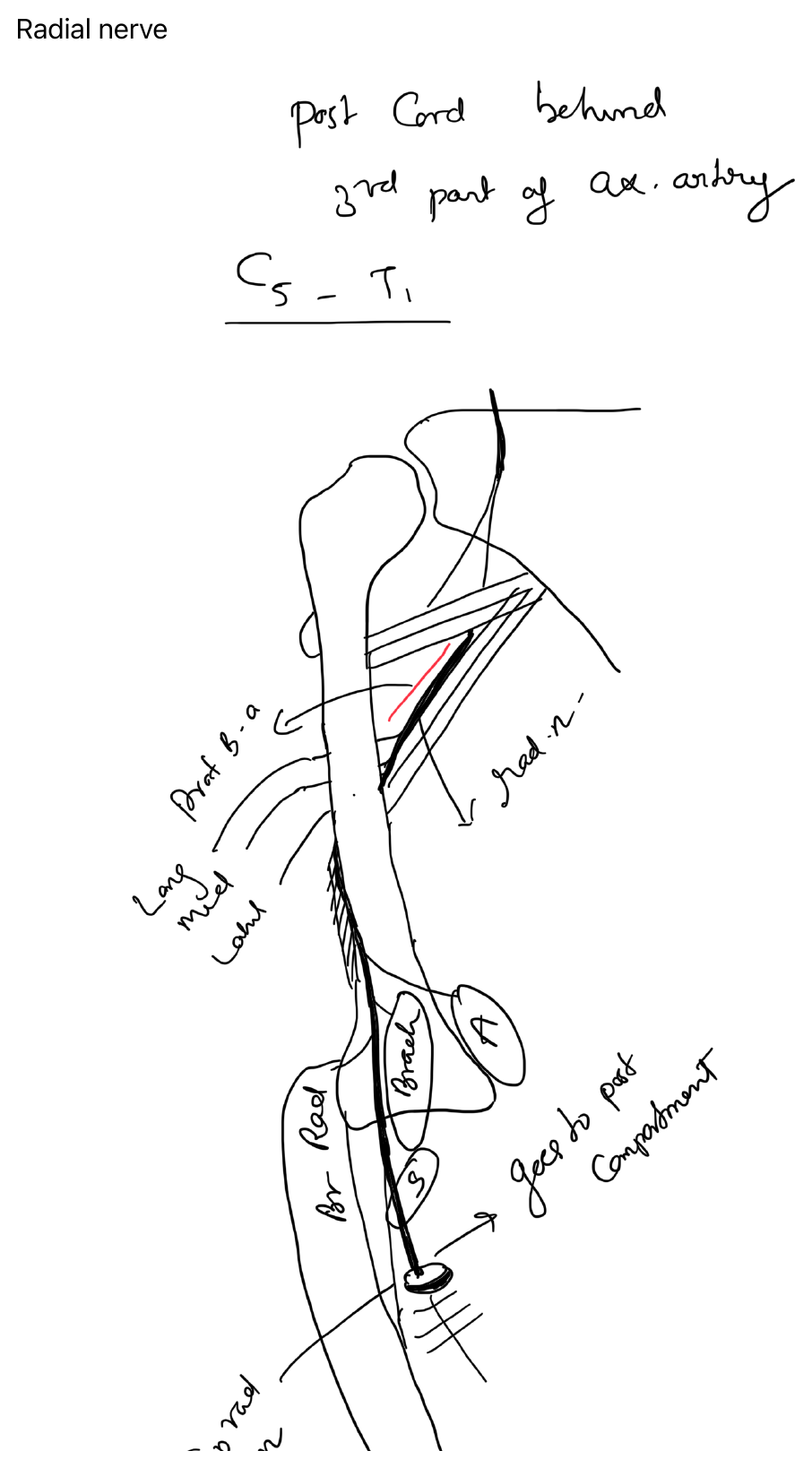
The radial nerve is the terminal branch of the posterior cord of the brachial plexus and contains fibres predominantly from C5-T1.
It passes:
- posterior to the axillary artery
- through the triangular interval with the profunda brachii artery
- along the radial groove of the humerus
- through the lateral intermuscular septum
- anterior to the lateral epicondyle, where it divides into superficial sensory and deep motor branches
Motor supply
Important muscles include:
- triceps
- brachioradialis
- extensor carpi radialis longus
- wrist and finger extensors through the posterior interosseous nerve
Sensory supply
Cutaneous branches supply the posterior arm and forearm and the dorsoradial hand, particularly the first dorsal web space through the superficial radial nerve.
Lesion localisation
Axilla
- triceps weakness may occur
- wrist drop
- finger extension weakness
- broad sensory loss
Humeral shaft / radial groove
- triceps usually preserved
- wrist and finger extension weak
- sensory loss over dorsoradial hand may occur
Posterior interosseous nerve
- finger and thumb extension weakness
- wrist extension may be preserved, often with radial deviation
- no cutaneous sensory loss
Examination
Test:
- elbow extension
- brachioradialis
- wrist extension
- finger MCP extension
- thumb extension
- first dorsal web-space sensation
Clinical relevance
The nerve is at risk in humeral shaft fractures, posterior humeral approaches, compression lesions and around the radial head / supinator.