Roots and origin
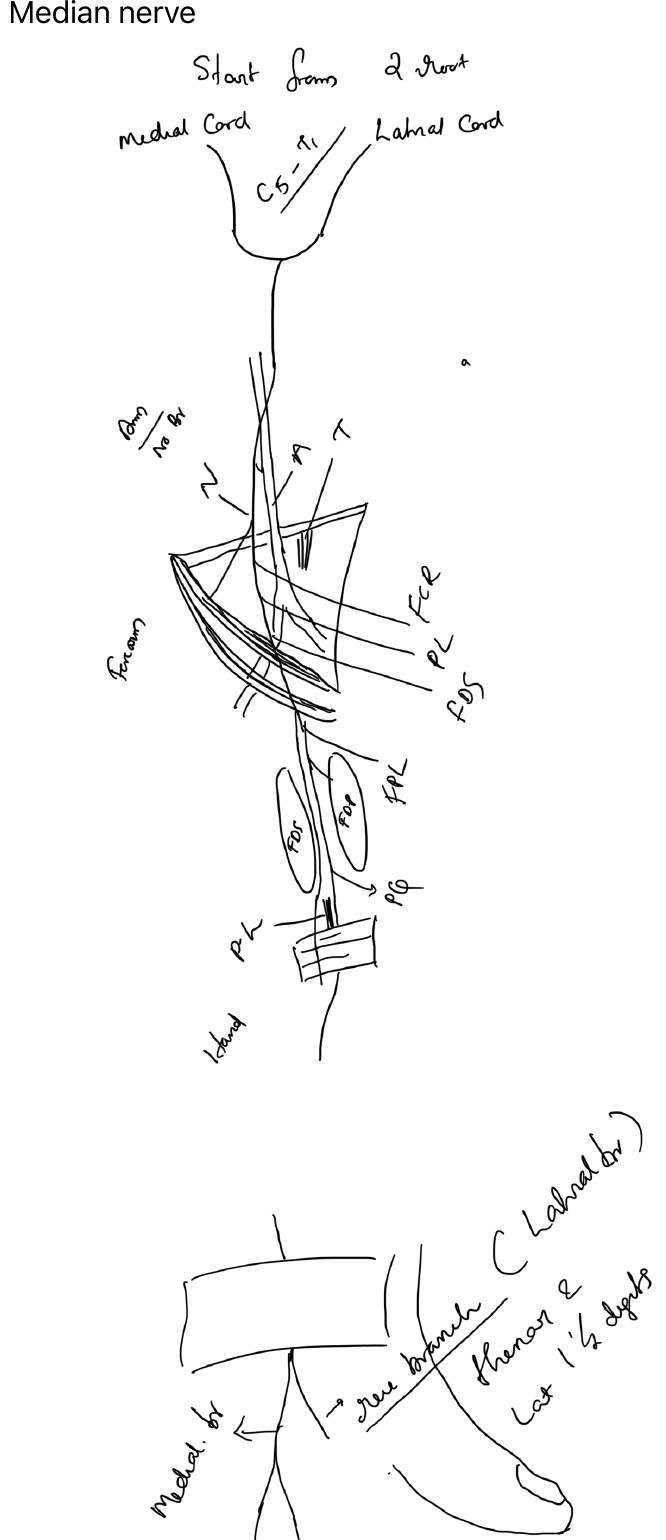
The median nerve is formed by contributions from the lateral and medial cords of the brachial plexus and contains fibres predominantly from C5–T1.
Course
Arm
- Runs with the brachial artery
- Lies lateral to the artery proximally and crosses to become medial distally
- Gives no major motor branches in the arm
Elbow and forearm
The nerve passes through the cubital fossa and enters the forearm between the heads of pronator teres. It then travels between flexor digitorum superficialis and flexor digitorum profundus.
Wrist and hand
The median nerve enters the hand through the carpal tunnel with the flexor tendons.
Major branches
Anterior interosseous nerve
Motor branch supplying:
- flexor pollicis longus
- pronator quadratus
- radial half of flexor digitorum profundus
AIN palsy produces weakness of the pinch mechanism and an abnormal “OK” sign.
Palmar cutaneous branch
Arises proximal to the carpal tunnel and travels superficial to the flexor retinaculum. It supplies sensation over the thenar eminence and central palm, so this area is usually spared in carpal tunnel syndrome.
Recurrent motor branch
Supplies the thenar muscles, particularly:
- abductor pollicis brevis
- opponens pollicis
- superficial head of flexor pollicis brevis
Motor supply
The median nerve supplies most forearm flexors except:
- flexor carpi ulnaris
- ulnar half of flexor digitorum profundus
In the hand it supplies the thenar muscles and the first two lumbricals.
Sensory supply
Palmar sensation to the radial three and a half digits, with dorsal sensation to the distal portions of these digits.
Common sites of compression
Pronator syndrome
Compression around the proximal forearm, commonly involving pronator teres or the arch of FDS.
Anterior interosseous neuropathy
Pure motor neuropathy without cutaneous sensory loss.
Carpal tunnel syndrome
Compression beneath the transverse carpal ligament. Typical features are nocturnal paraesthesia in the median distribution, thenar weakness in advanced disease and sparing of sensation over the thenar eminence.
References
- Orthobullets. Median Nerve.
- Orthobullets. Carpal Tunnel Syndrome.
- Orthobullets. AIN Neuropathy.