Medial collateral ligament complex
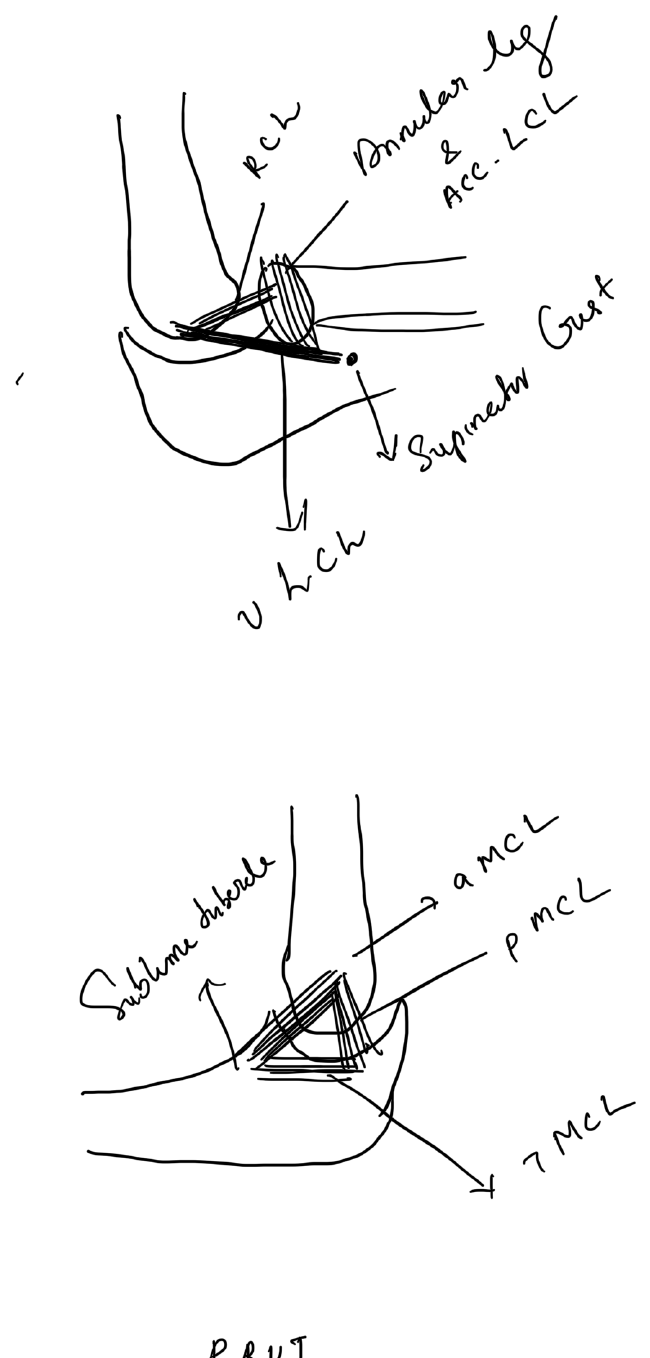
The medial collateral ligament complex is the principal soft-tissue restraint to valgus stress.
It has three components:
- Anterior bundle — strongest and most important component; primary valgus stabiliser through most of the functional arc
- Posterior bundle — becomes more important in flexion
- Transverse bundle — runs between the olecranon and coronoid and contributes little to valgus stability
The anterior bundle originates from the medial epicondyle and inserts on the sublime tubercle of the ulna.
Lateral collateral ligament complex
The lateral complex comprises:
- Radial collateral ligament
- Lateral ulnar collateral ligament (LUCL)
- Annular ligament
- Accessory lateral collateral ligament
The LUCL arises from the lateral epicondyle and inserts on the supinator crest of the ulna. It is the key restraint to posterolateral rotatory instability and an important stabiliser against varus and external-rotation stress.
The annular ligament encircles the radial head and stabilises the proximal radioulnar joint while allowing pronation and supination.
Functional stability of the elbow
Elbow stability depends on:
- ulnohumeral congruity
- radial head
- medial collateral ligament complex
- lateral collateral ligament complex
- dynamic muscular stabilisers
Loss of the lateral ligament complex may produce posterolateral rotatory instability. Medial collateral ligament injury is particularly important in valgus instability.
Clinical relevance
Medial instability
Seen with valgus overload, especially in throwing athletes. Tenderness is usually localised over the medial ligament and instability may be demonstrated with valgus stress testing.
Posterolateral rotatory instability
Usually follows injury to the LUCL complex. Patients may describe pain, clicking or a sense of instability when pushing up from a chair.
Diagram
References
- Orthobullets. Lateral Ulnar Collateral Ligament Injury (PLRI).
- Orthobullets. Terrible Triad Injury of Elbow.