Overview
Elbow arthroscopy is used for diagnosis and treatment of selected elbow conditions. It requires careful portal placement because neurovascular structures lie close to the capsule.
Common indications
- Removal of loose bodies
- Osteocapsular arthroplasty for stiffness or impingement
- Synovectomy
- Debridement in degenerative or inflammatory conditions
- Assessment and treatment of osteochondral lesions
- Selected instability or contracture procedures
Positioning
Common positions include:
- lateral decubitus
- prone
- supine with arm support
The joint is usually distended with saline before portal placement to increase the distance between the capsule and adjacent nerves.
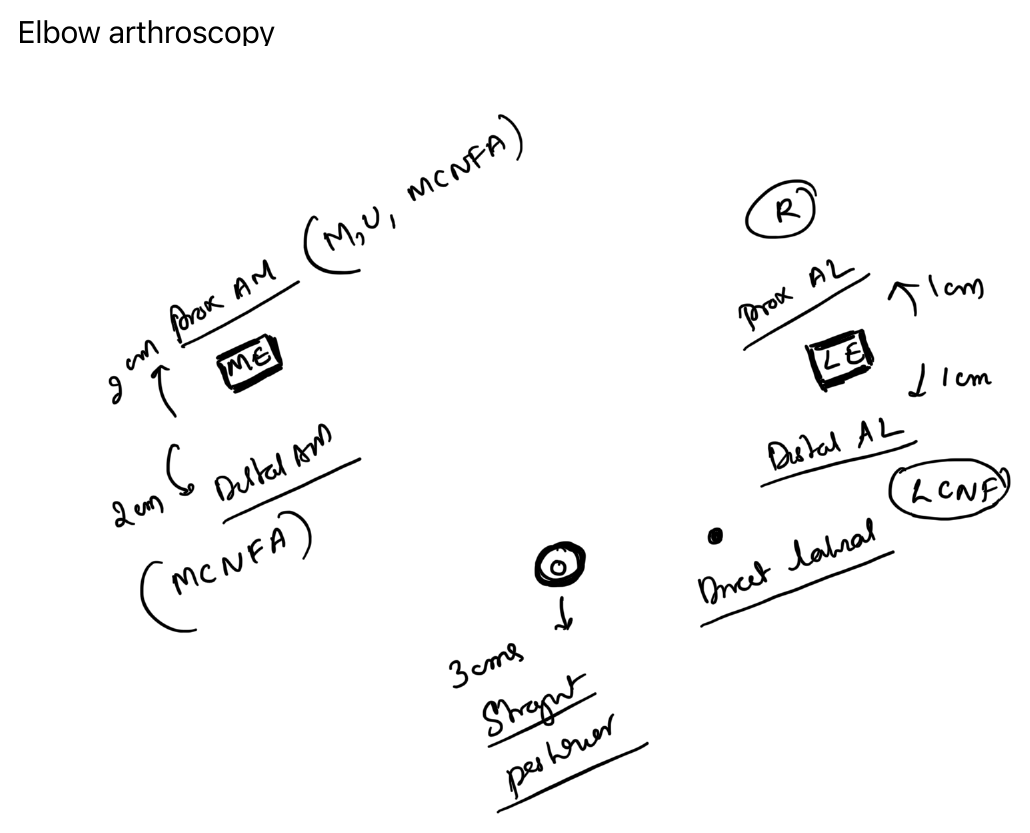
Important portals
Anterior compartment
- Proximal anteromedial portal
- Proximal anterolateral portal
- Mid-anterolateral portal in selected cases
Posterior compartment
- Posterolateral portal
- Direct posterior portal
Structures at risk
- Median nerve
- Radial nerve / posterior interosseous nerve
- Ulnar nerve
- Lateral antebrachial cutaneous nerve
- Medial antebrachial cutaneous nerve
Principles of safe arthroscopy
- Mark bony landmarks clearly
- Distend the joint before portal insertion
- Keep the elbow flexed where appropriate to move nerves away from the capsule
- Use blunt dissection down to capsule
- Keep instruments under visual control
Complications
- Nerve injury
- Extravasation and swelling
- Infection
- Instrument breakage
- Stiffness
- Persistent pain
Diagram