Clinical image
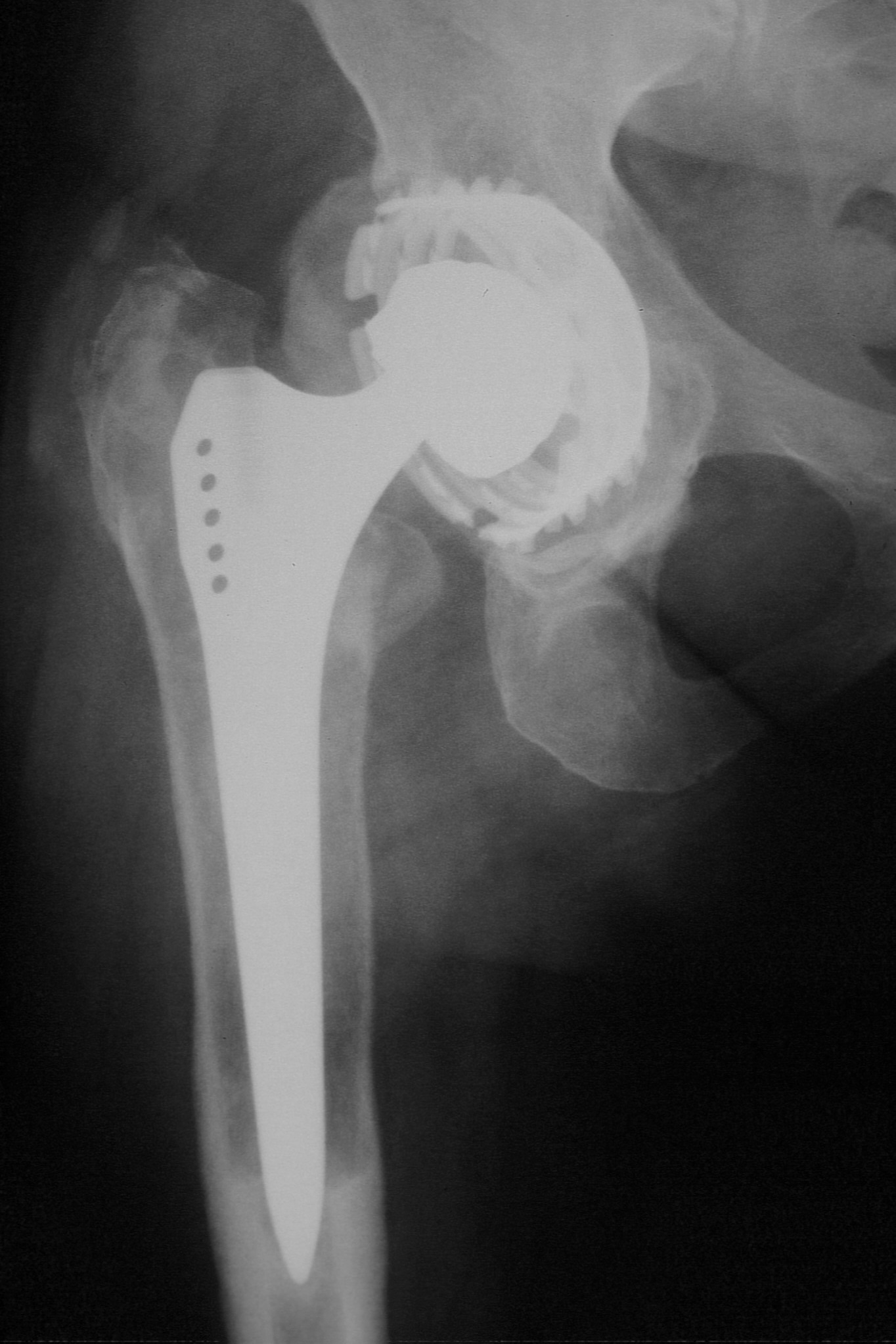
Massive osteolysis around a hip prosthesis; metallosis was found at revision. Source: Wikimedia Commons — Klaus Terstegge; CC BY-SA 3.0 DE. Image binary is embedded locally in this package; original source and licence are retained.

Talking the talk
- AP radiograph showing cemented THA, stanmore type.There is continuous radiolucency at the femoral cement bone interphase. Kohler line appears breached in the acetabular side. I would like to see the lateral view and the immediate post operative X-rays. I will consider the hip infected unless proved otherwise. How ever aseptic loosening due to PE wear is another strong possibility
wear
- Mechanism
- Modes
- Volume
What is wear?
- Progressive loss of bearing surface from the material as a result of chemical or
- mechanical action
- Abrasive: asperities sliding past each other generating particles from softer material
- Adhesive (main mode): Two opposing surfaces bond each other with transfer of material, with breaking at motion
- Fatigue or Fritting: Cyclic motion
Modes
- 1(Most common): between 2 bearing surfaces
- 2: between a bearing and non bering
- 3: 3rd body wear
- 4: between 2 non bearing
Factors affecting wear
- Implant
- Non cross linked poly
- gamma Radiation in air
- Long shelf life
- PE thickness
- Surgical
- Component position: Increased cup abduction angle
- Soft tissue tension
- Patient: Young and obese
UHMWPE
- Wear decreased by Highly CL PE but fracture resistance decreases
- Modifications
- impregnation with VE
- Sequential irradiation and annealing
- Photo induced polymerisation of MPC on to CLPE to create a hydrophilic layer for wettability
Effective joint space
- Schmalzreid
- All periprosthetic region to which joint fluid and hence the wear particle can reach
Osteolysis
- Loss of bone surrounding an artificial implant
- Periprosthetic interfacial membrane between bone and implant is implicated
- It is composed of 2 types of cells: Macrophage and fibroblast
- Macrophages activate osteolysis cascade
Key points
Definite features of Osteolysis Harris
- Stem subsidence
- Stem fracture
- Mantle fracture
- RL line not present post operatively
Cemented stem failure
Gruen
Gruen](THA wear_assets/slide-13-01.jpg)