Clinical image
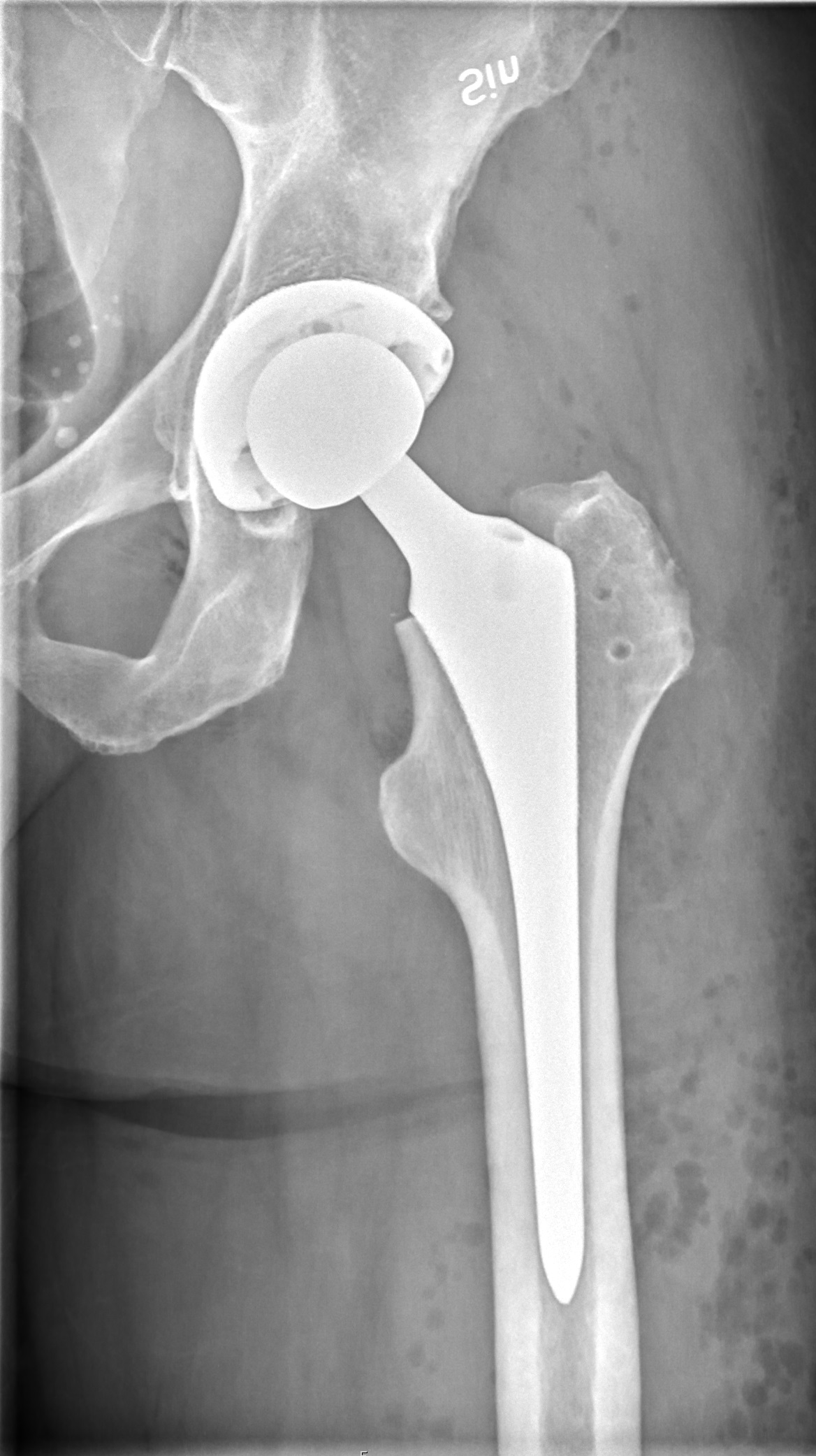
AP radiograph after total hip arthroplasty. Source: Wikimedia Commons — Mikael Häggström, M.D.; CC0 1.0. Image binary is embedded locally in this package; original source and licence are retained.

History
- Introduce
- Permission
Case History of Hip
- Pain:
- SLID
- Allergy
- Medical
- Social
- Summary
- Expectation
Pain-ODP
- Where is the pain
- Does it comes down to thigh or leg?
- How would you describe the pain you usually have in your hip?
- Mild, moderate or severe
- How painful is the hip when standing up from a chair after a meal?
- Do you limb because of pain while walking?
- How far can you walk before the hip prevents you?
- Do you have trouble walking upstairs?
- Do you have trouble washing and drying you up?
- Have you been troubled by pain from your hip in bed at night?
- Do you have trouble putting on socks?
- Do you have trouble getting in/out of car
- Can you do shopping
- Does it affect your work / hobby?
- What was done for pain
- Pain any where else
SLID
- has your hip become stiff?
- Limbing Childhood
- Symptoms of infection
- Discharging wound or scars
History continued
- Allergy
- Past medical: DM, Operations on that hip, Blood thinners, Steroids
- Social:
- Work,
- limitations now
- Smoking and alcohol
- Summarise to the patient
- What are your expectations?
Examination
- Stand and inspect front side and back
- Walk
- Trendelenberg test
- lie down and palpate: ASIS, Tr, Pulse
- Thomas test and ROM
- LLD
- Special tests
- Spine / pulse
Indications
- Severe disabling pain unresponsive to conservative measures, affecting ADL
- Medically fit
- No active infection
Surgical goals
- Relieve pain
- Improve function
Technical goals
- Correct limb length
- Correct offset
- Restore hip CoR
- Correct positioning of implant
- Position primary arc range with in the functional range required by patient
C/I
- Infection
- Neuropathy
- Vasculopathy
- Psychiatry
- Obesity
Compli
- Common (2-5%)
- DVT
- Dislocation
- Aseptic loosening
- Less common(1-2%)
- Infection
- Rare <1%
- LLD
- Periprosthetic fracture
- PE and death
- sciatic nerve palsy
Consent
- Goals
- Reported success rate (for the entire cohort 14 year revision rate is 7.27%
- cemented 4.88
- uncemented 8.94
- hybrid 5.38
- Complications
- Alternatives
- Shared care decision
Which implant fixation?
Which bearing surface?
- Most common construct recorded in NJR is cemented MoP , 4.87% revision in 14 years
75 years all combinations of bearing surface except MoM has similar results
- <55 years CoP tends to show the better results (<4%) when compared to MoP (8-10%) whether cemented or uncemented
THA of choice
- For most patients i will offer a cemented exeter hip, which has performed well in long term with a ODEP rating of A* at 10 years
- I will offer a ceramic femoral head and a 1st or 2nd gen XLPE
- in <55 years I will discuss the option of performing an uncemented THA
Cemented
- Immediate solid fixation
- Proven and durable
- Low failure rate
- Meets NICE guideline
- Cheaper
- Easier to revise
why not uncemented
- Dorr C femur
- Elderly
- Pathological bone
- Stress shielding, thigh pain
- Difficult to revise
Key points
Cemented THA
- Mechanical fixation
- Microinterlock with endosteal bone
- Cement will fatigue with cyclical loading
- Microfracture and fragmentation starts at stress point
- No remodelling
- Two interfaces: C-Bone, C-Implant
Design Principles
- Composite beam (shape closed) Charnley, Stanmore
- Taper slip (Force closed) Exeter
Composite Beam
- Rough surface
- Collared
- Rigid stem, no movement
- Stem acts as rod in 2 tubes
- Stability by friction
Charnley
- Matt
- 22 mm head
- Cobra flange to resist subsidence
- Flat back changed to round back for fatigue strength
- AP flange for cement pressurisation
Key points
Exeter Taper slip
- Polished
- Collarless
- Designed to subside in cement
- Centraliser void prevent cement fracture
- Hoop stress generated, producing radial compression
Centraliser
- Helps stem subsidence
- Seals effective joint space
- Better cement mantle
- Reduce cement cracking by decreasing tensive forces
Cement
- Content, property and uses
- Generations
Key points
| Generation | first | second | third | Fourth |
|---|---|---|---|---|
| Mixing | Bowl | Bowl | Vacuum | Vacuum |
| Gun | No | Yes | Yes | Yes |
| Restricter | No | Yes | Yes | Yes |
| Pulse lavage | No | No | Yes | Yes |
| Pressurisation | No | No | Yes | Yes |
| Centraliser | No | No | No | Yes |
| Improvement | ||||
| Mantle | No | Yes | Yes | Yes |
| C quality | No | No | Yes | Yes |
| Stem position | No | No | No | Yes |
| Strength | Factors |
|---|---|
| Un Controllable | Moisture; Aging; Fatigue |
| Partly controllable | Blood and tissue; Stress raisers |
| Fully controllable | Antibiotic; Vacuum; Presurisation; mixing speed; Radioopaque filler |
Mandle
Gruen Zones
- To diagnose osteolysis and cement fracture
Gruen Modes of Failure
Causes of cement Mandle Fracture
- Stress in excess of endurance limit is the cause
- Reduced by
- optimally thick
- Symmetric
- Homogenous mantle
How to achieve this
- Avoid stem mal alignment
- Proximal medial mandle 2-5mm
- Preserve 2-3mm proximal medial cancellous bone
- Stem centraliser
- Improve cement quality
- Better cementing technique
Uncemented THA
Principle
- Dynamic biological fixation with potential lifelong dynamic bond b/w bone and implant
- only one interface
- Two methods
- Bone ingrowth: porous coating
- Bone ongrowth: Rough metal surface by grit blasting/plasma spray
Ingrowth: Rule of 50
- Pore size 50 microns
- Pore depth: 50
- Porosity: 50%
- Gap : 50
- micromotion: 50
- Press fit: 1-2mm larger implant
- Line to line: require additional fixation initially
- Scratich/frictional
Stem sinkage
- Assessed by Engh radiological criteria
- Under size
- poor bone stock
- large BMI
Engh
- First degree – a slight rounding off of the proximal medial edge of the cut femoral neck.
- Second degree – a rounding off of the proximal medial femoral neck combined with loss of medial cortical density at level 1 on the anteroposterior (AP) radiographs.
- Third degree – more extensive resorption of the cortical bone extending from level 1 into level 2.
- Fourth degree – severe resorption of cortical bone extending below levels 1 and 2 into the diaphysis.
Key points
- femoral component stability.
- A stable implant demonstrated no migration and spot welds.
- Stable fibrous ingrowth occurred when an implant showed no progressive migration, sclerotic lines around the porous surface and less atrophy of the medial femoral neck than observed when bone growth occurs.
- An unstable implant was defined as one with definite evidence of progressive subsidence or migration of the implant. Increased cortical density and thickening typically occur beneath the collar and at the end of the stem.
Ongrowth
- Initial press fit
- Bone grows on to divots
- Depends on surface roughness
- Implant usually titanium
- Hydroxyapatite surface coating: 50micron thick
Ceramic
- Inorganic material made up of combination of metallic and non metallic elements bonded ionically in high oxidised state
Key points
| Advantage | Disadvantage |
|---|---|
| Better lubrication, friction and wear prop | Brittle |
| Hard | Catastrophic failure |
| Low co of friction | No plastic deformation |
| Wettable | Squeaking |
| Biocompatable | Less range of size |
| Bioinert | cost |
| No corrosion | |
| no ion release |
Manufacture-Sintering
- Made in to slurry of ceramic powder and water
- Pressed mechanically
- Hot isostatic pressing
- Grinding and polishing using diamond wheel
- Stress testing
Generations
- 1st: 13% fracture
- 2nd: 5%
- 3rd: Delta alumina : 0.18%
- 4th gen Biolax Delta: 0.003%
Biolax Delta
- Composition
- Al, Zir, Strontium
- 1st toughening: Transformational toughening
- Z particles act like airbags
- 2nd toughening: Platelet like crystals
Revision
- Once ceramic, always ceramic
- Revise all
Liner failure
- Liner fracture
- Incomplete sitting
- Peripheral chipping
- Morse taper
- Cup deformation
- Inaccurate cup position
- Edge loading: Microseperation
- Medialised cup
- Stem subsidence
- Impingement
- Head size over 36mm: Positive offset
- Edge loading: Microseperation
- Incomplete sitting
Stripe line
- Area of roughness created on cup and head due to repeated subclinical subluxation.
- Due to increased lever range
- Reduced by reducing lever range by
- Better design
- Positioning and offset
Polyethylene
- Long chain polymer of ethylene monomer (C2H4)
- Mol wt: 2-5 x 10⁶
- Viscoelastic and undergo strain hardening
- Used as bearing surface
Wear properties
- Manufacture
- Ram bar
- Direct compression moulding
- Ca stearate
- Sterilisation
- Gamma radiation in presence of air: Chain scission
- Storage:
- Long shelf life lead to oxidation
- Package: air leaking
Highy cross linked PE
- High dose radiation induce cross linking
- Better wear property
- More brittle
- Hard
- Stiff
- Reduced UTS
- reduced work hardening
2nd Gen XPE
- Vit E treatment
- Post production anniling
Modes of failure
- Aseptic loosening
- Dislocation
- Fracture
- Liner failure
- Edge loading
- Squeaking
Complications
HO
- 43%, 9% high grade brooker
- Patient factors
- An Sp
- Pagets
- Post trauma
- DISH
- Surgical factors
- Muscle ischemia
- Lateral approach
- Bone trauma
- Bone debris
HO Prophylaxis
- Indomethacin 75 mg 6 weeks
- Single peri op RT 700cGy (4hr before to 72 hrs after)
- Combined RT and indo