Clinical image
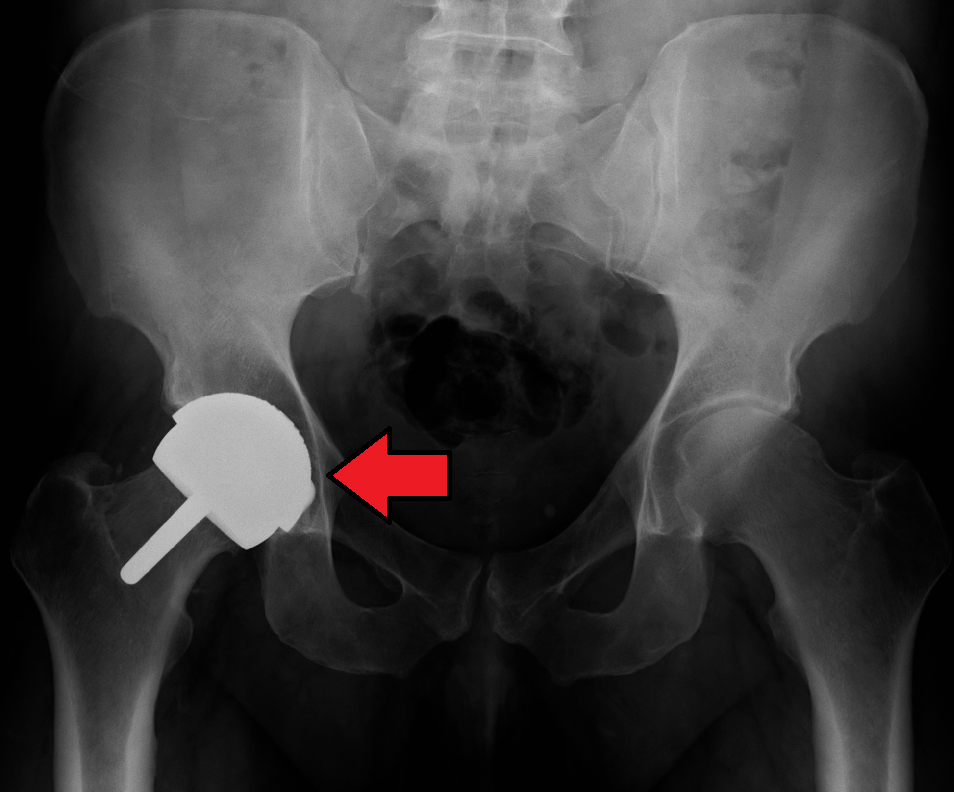
Metal-on-metal prosthetic hip. Source: Wikimedia Commons — James Heilman, MD; CC BY-SA 4.0. Image binary is embedded locally in this package; original source and licence are retained.

Why?
- Improved ROM
- Better gait
- reduced dislocation
- Reduced stress shielding
- Less infection
- Less DVT/PE
- Preserves bone stock
- Preserved BMD in Gruen 7 zone
Key points
Look for
- Abduction angle (40 degree)
- Mention Head size (minimum 46 mm)
- Metaphysial radiolucency
- Narrowing/fracture of neck
- Divot sign:Depression of neck contour just below the junction with femoral component, often associated with reactive exostosis. Sign of impingement
Indications
- Young man with normal anatomy and primary OA
- C/I
- Small head and neck, deformed acetabulum
- Progressive disease: inflammatory disease
- Large cyst/ AVN
- Female who want children
- Large BMI>35kg/m2
- Osteoporosis
Complications
- Femoral neck # 1-3%
- Parient causes
- Female, bone quality
- Surgeon causes
- Experience
- Technical causes
- Head size
- notching
- component malposition
- Inadequate blood supply
- Posterior approach
- Parient causes
Technical cause reduction
- Templating
- Upsizing head
- Proper jig
- Surgeon experience (De Smith JBJS Am)
- Minimum 200 THA before resurfacing
- learning curve 20-50 resurfacing to overcome
- Computer navigation to prevent mal position
Compli
- Loosening: More common in females
- Metallosis: Macroscopic staining of soft tissue and is associated with abnormal wear
ALVAL and Pseudotumour
- Aseptic lymphocyte dominated Vasculitis associated lesion is cause by metal particle debris.
- Patient presents with localised pain and osteolytic reaction. More severe form is pseudotumor
ALVAL and Pseudo Tr
- ALVAL is Delayed Hypersensitivity reaction
- Ps Tr is a characterised by formation of synovial like bio-membrane which can produce collagenase, IL1 and TNF, leading to bone resorption and osteolysis. It is neither malignant nor infective
- Diagnosis by USG and MARS
pathology
- Wear
- Hypersensitivity
- Combination of two
- Unknown
Causes
- Component malposition
- Abduction angle of acetabulum >35 degree
- Jumbo head in THA
- Small head resurfacing
- female
- Trunnionosis: Narrow Head neck taper and large head leading to corrosive wear at trunnion
Painful MoM
- I will first exclude infection
- Causes can be extrinsic or intrinsic
- Exclude
- Referred pain
- Soft tissue causes: psoas/abductor tendinosis, impingement
- POVD
- Stress fracture
- Component malposition
- Femoral neck fracture
- Aseptic loosening
- Heterotropic ossification
- I will follow BHS guideline for MoM once these causes are excluded
Rule out ARMD
- Look for groin swelling, hip pain, limping and decreased ROM
- Measure metal ions: may not be raised in MoM THA
- MARS/USG: most important,(Look for muscle/bone damage)
- then observe
- if no fluid collection, mass
- ions static
- then observe
Followup MoM
- ASR
- Female resurfacing
- Male small resurfacing < 48
- Jumbo THA head >36
- Other Symptomatic MoM
- Oxford HS
- Blood metal ions
- Annual follow up
- MARS/USG if
- worsening OHS
7ppb metal ions
Other Asymptomatic
- ODEP rated: First year, 7th year the 3 yearly
- Non ODEP rated: Yearly for 5 years, 2 yearly for 10 years, the 3 yearly afterwards
Management of pseudotumor
- Get second opinion
- Aggressive debridement
- Keep the option of constrained cup as soft tissue may be defective
- MoP, uncemented
ASR
- Sub hemispherical cup to reduce impingement
- Internal groove design to accommodate insert
- effective arc was reduced, edge loading occurs
- Suboptimal manufacturing of CCM
- High failure rate