Clinical image
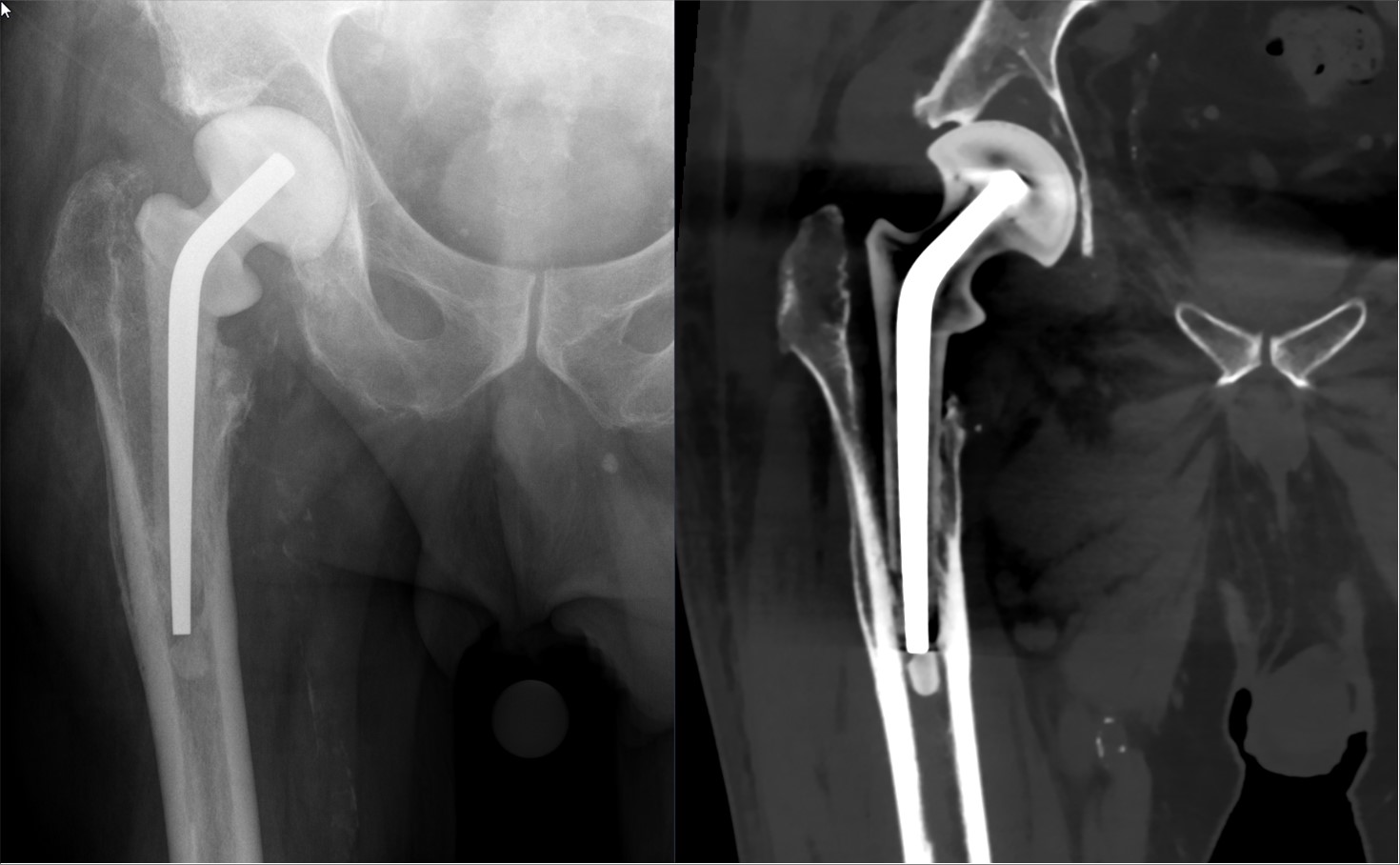
Temporary hip spacer used in treatment of an infected hip arthroplasty. Source: Wikimedia Commons — Hellerhoff; CC BY-SA 4.0. Image binary is embedded locally in this package; original source and licence are retained.

Key points
- This is the supine AP front view of the left hip showing a cemented THA.
- What concerns me is the radiolucencies seen in the Gruen zones 1,2,4, and 7. The acetabulum looks well fixed but there is suspect lucent zone in charnley zone 3. I would like to see the immediate post operative X-ray to know whether the stem has sunk and latest lateral view of left hip.
What do you think?
- The prosthesis appears loose. It was inserted only 3 years back. The radiographs are highly suggestive of infection until proven otherwise.
- I would take a thorough history covering the reason for the procedure, any leaking wound after surgery, UTI, chest infection or dental extraction, immunosuppressive comorbidities and smoking. I wound examine for signs of inflammation, health of the scar and do Full blood count, ESR and CRP
- I will aspirate the hip if the pretest probability is high, especially if ESR and CRP are elevated.
Causes
- Pre operative
- Per operative
- Post operative
Preoperative
- Potential septic lesions
- Comorbidities
- Admission: better is same day
- Separation from trauma
- Preparation: better is in anaesthetic room
Peroperative
- Antibiotic prophylaxis
- Surgical technique
- Attire and behaviour
- Movement in theatre
- Ace Mask
- Weaved pattern gowns
- 2 pair gloves
- No hair exposed
- Body exhaust system
- Disposable non woven drapes
- Theatre and ventilation
Postoperative
- Catheter with antibiotic cover
- Special surgical ward
- Hand hygiene
Investigations
- FBC
- ESR
- CRP
- IL6
- Xray
- Bone scan
- Do not routinely aspirate (only if pretest probability is high)
Management
- Long term antibiotic suppression
- Elderly unfit patient
- DAIR
- Healthy patient
- Known organism
- Stable component
- Skin and soft tissue good
- Single stage revision (Butchholz 77% success rate)
- Two stage revision (6 weeks delay) Norvegian registry 94% success
Single stage
| Advantages | Disadvantages |
|---|---|
| One operation | Prolonged procedure |
| Mobility | Ab Sensitivity should be known |
| No disuse atrophy | Ab cement must |
| Reduce cost | Bone loss is C/I |
Two stage revision
| Advantages | Disadvantage |
|---|---|
| Adequate debridement | More morbidity |
| Appropriate Ab can be given | Prolonged rest and disuse atrophy |
| Better assessment of infection control | Increased cost |
| Allows uncemented | 2nd surgery more complicated |
| Allows BG | Less functional outcome |
PROSTALAC
- Maintain soft tissue
- Delivers high conc of antibiotic
- Maintain LL
- Articulating spacer helps partial/full weight bearing
Salvage
- Resection
- Arthrodesis
- Amputation