Clinical image
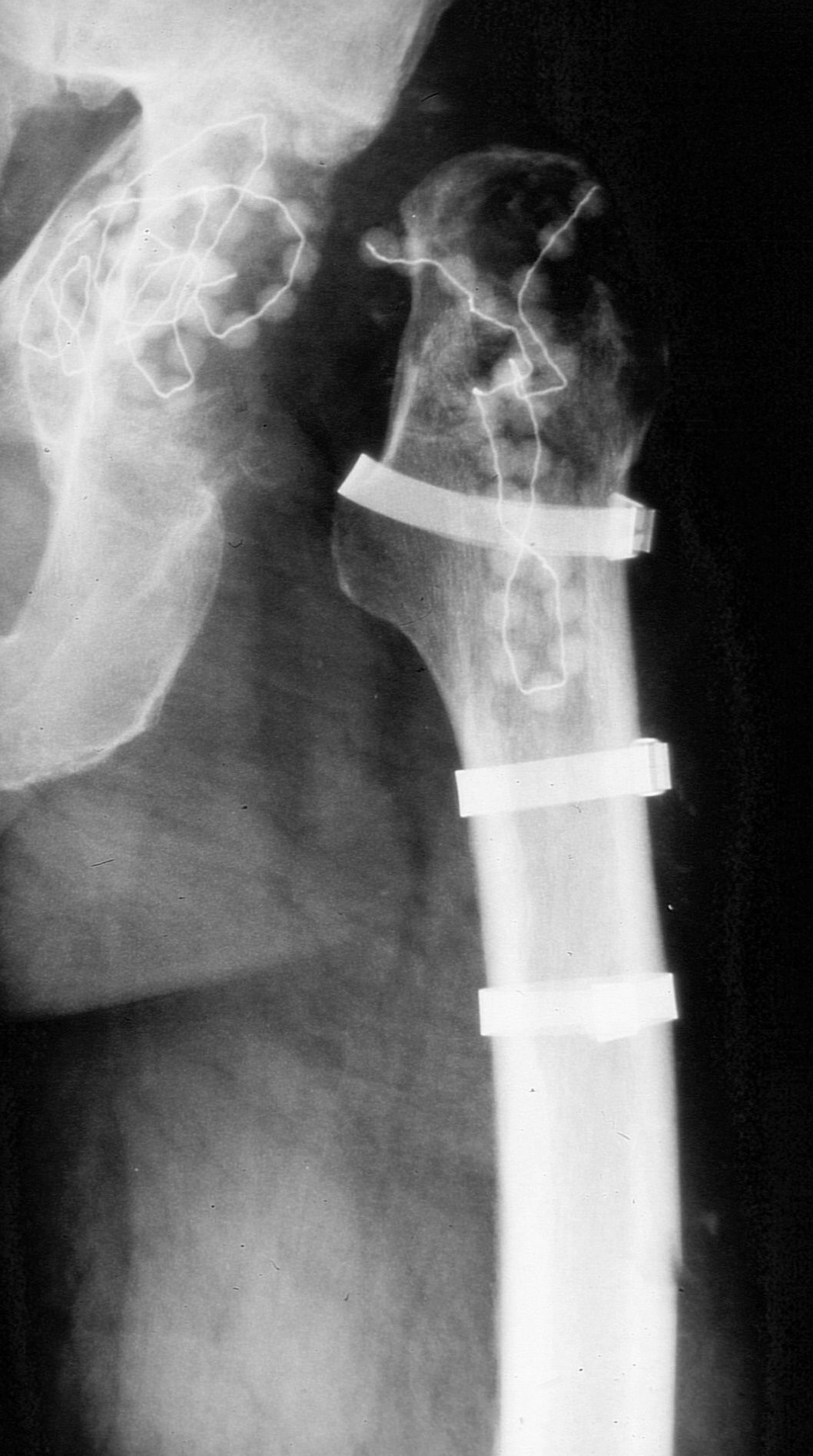
Girdlestone situation after removal of an infected hip prosthesis. Source: Wikimedia Commons — Mehlauge; CC BY-SA 3.0. Image binary is embedded locally in this package; original source and licence are retained.

Key points
Talking the talk
- This is the supine AP front view of the left hip showing a modular bipolar hemiarthroplasty.
- What concerns me is the radiolucencies seen in the Gruen zones 1,2,4, and 7. There appears to be a cortical break below the lesser trochanter. The acetabulum is porotic but head size not under or over sized. I would like to see the immediate post operative X-ray to know whether the stem has sunk and latest lateral view of left hip.
What do you think?
- The prosthesis appears loose. It was inserted only 3 years back. The radiographs are highly suggestive of infection until proven otherwise.
- I would take a thorough history covering the reason for the procedure, any leaking wound after surgery, UTI, chest infection or dental extraction, immunosuppressive comorbidities and smoking. I wound examine for signs of inflammation, health of the scar and do Full blood count, ESR and CRP
- I will aspirate the hip if the pretest probability is high, especially if ESR and CRP are elevated.
How good is ESR and CRP
- IL 6 more accurate than ESR and CRP (Berbari, JBJS am, 2010)
How useful is aspiration?
- Image guided aspiration is highly sensitive and specific with high negative predictive value (all around 90%, but 67% PPV), especially with clinical features suggestive of infection or when ESR and CRP elevated. Spangehl JBJS Am, 1999
If aspiration negative
- Bone scan T99 M Low specificity
- Indium Leukocyte-more specific and sensitive
- FDG-PET- Sensitive, does not diff infection from aseptic loosening
What would you do
- I will sit with the patient and fully discuss what her problems and expectations are.
- We have to reach an agreement on whether she would wish to proceed with revision surgery taking on board the potential risks and complications of surgery weighted against the probable benefits.
- Proceed with 2 stage revision
Tsukayama Classification
- Early Postoperative
- Late Chronic
- Haematogenous
- Intraoperative
Prerequisites of 1 stage procedure
- Known organism , sensitive to Ab
- No pus
- Elderly/patients with multiple medical problems
- Success rate 0f 80% if antibiotic loaded cement used against 60% if not (Hanssen and Rand, JBJS 1998)
Advantages and Disadv of 2 stage procedure
- More versatile: cemented/ uncemented/ bonegraft
- Allows assessment of response to antibiotics
- Difficult nursing
- Difficult second surgery due to scarring, shortening and atrophy
- PROSTALAC spacer is costly, can dislocate and fracture
Duration of antibiotics
- No clear guideline
- Wait for at least 6 week looking for good response
- Most surgeons do 2nd stage at 3 months, 6 weeks antibiotics and further 6 weeks with out, monitoring CRP and ESR
- Some aspirate before the procedure
5/6 of my last operations got infected
Theatre design
Principles
- Stop operating and investigate
- Find out whether organism was same: Staph aureus then nasal carrier-take swabs an appropriate treatment
- Look for breakdown of theatre sterility: Microbiology investigate for laminar flow system
- Fischer index :
- at rest:<9 cfm /dm2/h
- in activity: < 90/dm2/h
- Instrument sterilisation and packing
- Intra operative precautions breakdown
- too much movement
- opening and closing door
Theatre sterility
- Operation theatre quality
- Structure:
- clean, sterile and dirty areas clearly demarcated
- Surfaces easy to clean
- Contamination controlled airflow system (HVAC system) ;Controls temperature, humidity and airflow
- Involves: Ventilation, pressurisation, filtration and air distribution
- HEPA filter 99.97% reduction of particles above 0.3 microns
- Ventilation
- Structure:
- Water supply
- Procedural and Behavioural factors
- Attire
- Preparation in another room
- Use correct plenum
- Limiting needless activity
- WHO check list
Ventilation
- Unidirectional
- LAF
- Horizontal
- Vertical
- Exponential
- LAF
- Turbulent
- Mixed
Classic studies
- Charnley: 7% reduced to 0.5% with
- Unidirectional flow
- High pressure
- Exhaust suit
- High rate of air exchange
- Lidwell: Further reduction in infection with ultra clean air
- A meta-analysis encompassing 26 studies could not ultimately confirm the role of LAF in surgery
- Some recent studies have even indicated an increase in SSI after hip prosthesis with procedures performed under LAF (Christian Brandt, germany)