Clinical image
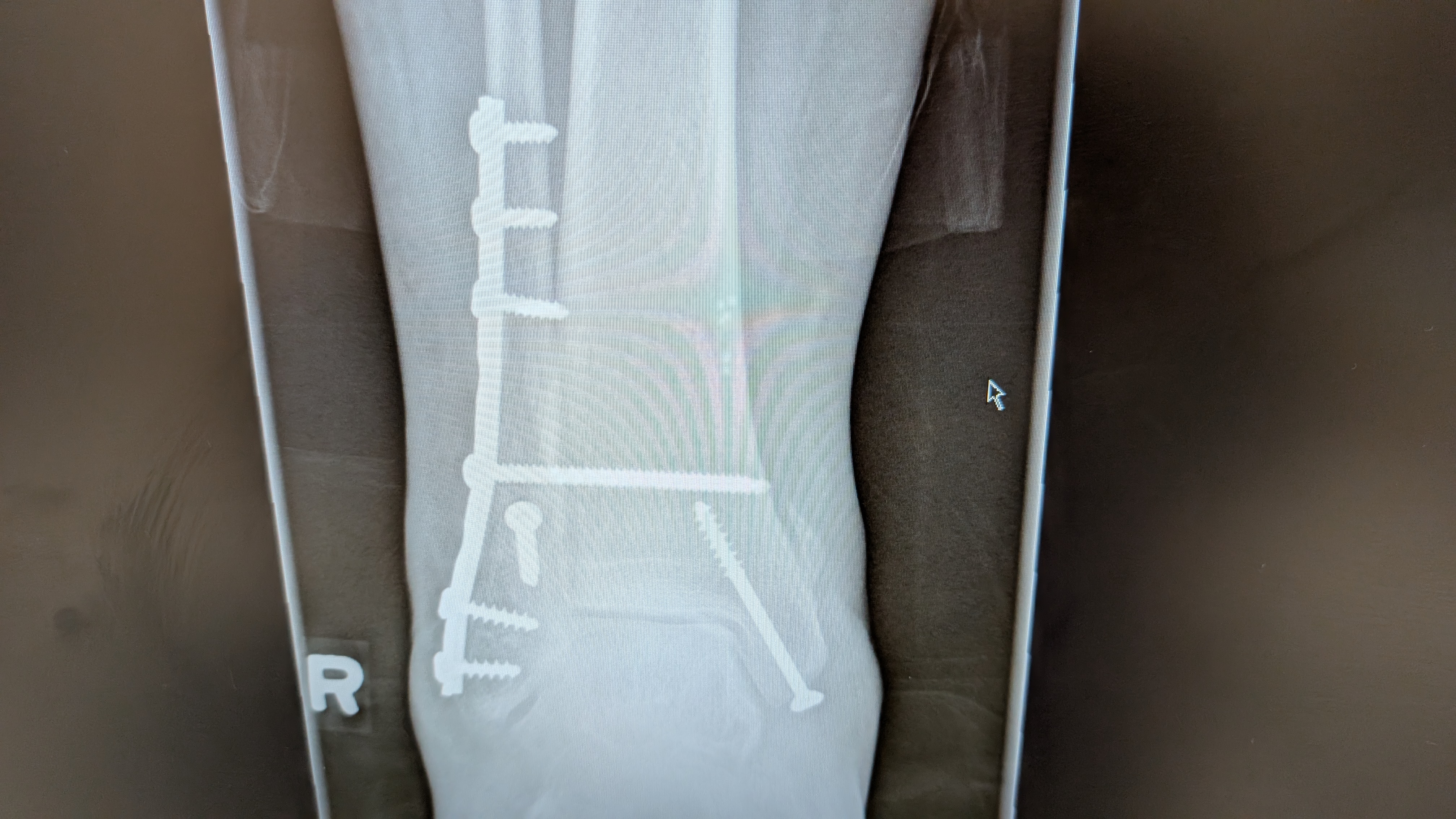
Plate fixation of an ankle fracture. Source: Wikimedia Commons — গীতাশ্ৰী গগৈ আপ্তে; CC BY 4.0. Image binary is embedded locally in this package; original source and licence are retained.

- Plates
Key points
What plate you will use?
I use the xxxx plate because it is perfect/ I like it/ My hospital supplies it/ my rep says
it is the best
Q: Design the perfect Plate/IM Nail?/
what plate you prefer?
Choice of implant ?
I use the xxxx plate because it is perfect/ I like it/ My hospital supplies it/ my rep says
it is the best
Summary
- don't jump to implants
- Question is about your understanding of concepts and their application
- Structure your answer
Q: Design the perfect Plate/IM Nail?/
what plate you prefer?
Choice of implant ?
The choice/design of implant require consideration of the following factors
Material Properties
Structural properties
Interface of fixation
Modality of use
Ideal material
My ideal material
- Should be Bio-inert, reliable, easily manufactured and sterilisable. It should be prize and corrosion resistant, ductile, tough and hard
Example:
Stainless steel 316 L
Titanium Alloy 6Al4V (T 89%, Al 6%, V 4%)
Cobalt Chromium Alloy
(iron 62%, Chromium 18%, M 3% N16% Carbon <= 0.03, low)
Metals
Crystalline structure
Metal ions are +ve, they are packed by
- Hexagonal close pack 12
- Face centred cubes 12
- Body centred cubes 8
Coordination number: no of neighbours
Grain boundaries: where one crystal meet the next
Dislocations: irregularities in the crystal
Why metals are ductile?
- Due to movement of dislocations through lattices
- Slipping of +ve ions over each other to form new bonds with delocalised electrons
- Grain boundaries resist slipping and decreases ductility
- Annealing increases ductility (decrease dislocations)
- Alloying, quenching and cold working decreases ductility
Material Property
- Youngs Modulus : stiffness (GPa)
- Elasticity/Plasticity
- Yield Point
- Brittle/Ductile
- Toughness
- Hardness
- Endurance limit
Key points
?
- Brittle: exhibits elastic property up to point of failure
- Ductile: undergo permanent deformation before complete failure
- Hardness: ability to resist scratch
- Toughness: energy per unit area absorbed before breakage
- Endurance limit: max stress below which material will not fail regardless of number of loading cycle(10 million in ortho)
SS 316 L
- Chromium: Corrosion
- Nickel: Stabilise austenite to steel
- Molybdenum: Protective mould from exposure to acid
- No ferrate element: non magnetic
- No inclusion: means no sulphur, less corrosion
Key points
| SS316L | CCM | VAT |
|---|---|---|
| Cheap; easy to manuf | exp | exp |
| Properties; well Known; Biocompactable | do | do |
| Tough; Ductile | Tougher | Less tough |
| High Y: stress Shielding | do | low Y |
| Fatigue resist | Hard; Wear resist | Soft; Self passive |
| Stress corrosion cracking | corrosion resist | corro rest; Notch sen |
Structural Properties
- Cantilever bending (Axial stiffness)
- Bending stiffness
- torsional stiffness
Cross sectional shape
- Stiffness depends on the radius or height and breadth of material
- Increasing this will increase second moment area and increases stiffness
- rod r4
- Beam: wh3
Key points
Girders
Cantilever
- strain is proportional to the square of distance of the force from the fixation point
Interface fixation
- Conventional screws
- Compression
- Plate friction
- Locking screws
- Fixed angle device
- combination
Screw
- Definitions
- pitch
- distance between threads
- lead
- distance advanced with one revolution
- screw working distance (length)
- defined as the length of bone traversed by the screw
- outer diameter
- root (inner) diameter
- bending strength is proportionate to inner (minor) diameter3
- pullout strength is proportionate to outer (major) diameter2
- maximized by
- large outer diameter difference
- fine pitch
- pedicle screw pullout most affected by quality of bone (degree of osteoporosis)
- maximized by
- pitch
- Types of screws
- cortical screws
- cancellous screws
- locking screws
Conventional screw
- Depends on compression on to the bone to resist shear forces
- Individual screw fails sequentially
- Only distal tip resists pull out
- Only proximal part in contact with bone resist shear
Key points
Locking screw
- enblock pull out
- entire screw resist shear force
- Angular stability
Key points
Blood supply
- High pressure nutrient artery system
- Low pressure periosteal system
- M-E system (Dale and Harris A and B)
Preservation of blood supply
- Plate design = Low contact Application: Internal Ex Fix
Key points
Combi Holes Plate
- Intra operative flexibility
- Less number of plates in the shelf
Pre contoured and fracture specific plate
- Variable angle plate
- Fixed angle plate
Modality of use
what are my intentions
how i can achieve those intentions
How i hold my intentions until fracture unites
Primary vs secondary healing
Anatomical vs alignment
Rigid vs relative
Load sharing vs bearing
combination
straight vs variable locking
Key points
- What plate you will use?
One way
- Assuming that this is an isolated closed injury and the limb is neurovasularly intact, after adequate consent, my positioning of the patient is
- My intention of fixation is
- I will achieve the goal by
- I will hold the fixation till the fracture heals byfixation
What is working length?
- Un supported length of construct
- How to increase rigidity?
- How does that increase rigidity?
Increase rigidity
- Material properties: Stiffer material
- Structural properties: Increase pin and rod diameter
- Interface fixation: decrease working length of pin and fixator
- Modality of fixation: Load sharing by anatomical reduction
Key points
What is working length?
What is working length?
There are four ways of obtaining interfragmentary compression with a plate:
- compression with the dynamic compression unit in a plate (LC-DCP);
- compression by contouring (overbending) the plate;
- compression by additional lag screws through plate holes;
- compression with the articulated tension device.
Buttress Plate
- To prevent any sliding of the plate, the screw is placed as proximal as possible in the hole.