Principles
Traction applies a controlled longitudinal force to a limb or the spine. Its purposes include:
- Reduction or maintenance of fracture alignment
- Temporary stabilisation
- Reduction of muscle spasm
- Pain relief
- Prevention or correction of deformity in selected conditions
Traction requires an opposing counter-traction force.
Types
Skin traction
The force is transmitted through the skin using adhesive or non-adhesive devices.
Advantages
- Simple
- Non-invasive
Limitations
- Lower permissible loads
- Risk of skin injury
- Less precise control
Skeletal traction
Force is applied directly to bone through a pin or wire.
Common sites include:
- Distal femur
- Proximal tibia
- Calcaneum
Skeletal traction allows greater force but carries risks of pin-site infection, neurovascular injury and physeal injury in children.
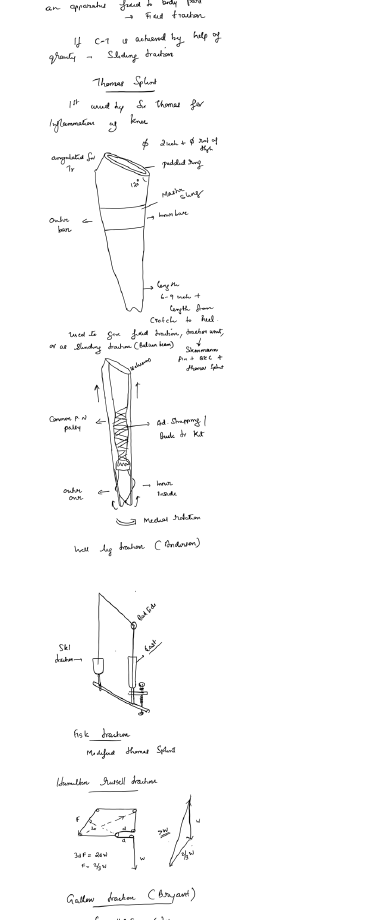
Mechanical principles
- The traction line should act in the desired direction of correction.
- Pulleys alter the direction of force but an ideal pulley does not alter its magnitude.
- Friction reduces effective traction.
- Counter-traction may be provided by body weight, bed tilt or another applied force.
Clinical care
- Check neurovascular status
- Inspect skin or pin sites regularly
- Ensure weights hang freely
- Ensure ropes run freely in pulleys
- Maintain correct limb alignment
- Prevent pressure sores and venous complications
Complications
- Skin breakdown
- Pin-site infection
- Neurovascular injury
- Joint stiffness
- Pressure injury
- VTE
- Loss of reduction
References
- Orthopaedic trauma principles of skin and skeletal traction.