Definitions
- Spondylolysis: defect in the pars interarticularis
- Spondylolisthesis: translation of one vertebral body relative to the vertebra below
Common level
Isthmic spondylolisthesis most commonly affects L5–S1.
Wiltse-Newman classification
- Type I — dysplastic
- Type II — isthmic
- IIA: pars fatigue fracture
- IIB: elongated pars after repeated stress injury
- IIC: acute pars fracture
- Type III — degenerative
- Type IV — traumatic
- Type V — pathological / neoplastic
Meyerding grading
- Grade I: <25% slip
- Grade II: 25–50%
- Grade III: 50–75%
- Grade IV: 75–100%
- Grade V: spondyloptosis
Clinical features
- Low back pain
- Hamstring tightness
- Radicular pain, particularly L5 symptoms in L5–S1 isthmic disease
- Step deformity in larger slips
- Neurological deficit is uncommon in low-grade slips but must be assessed
Imaging
Plain radiographs
- Standing AP and lateral radiographs
- Flexion-extension views when instability is suspected
- Oblique radiographs may show a pars defect but are not always necessary
MRI
Useful for neural compression and associated disc degeneration.
Spinopelvic parameters
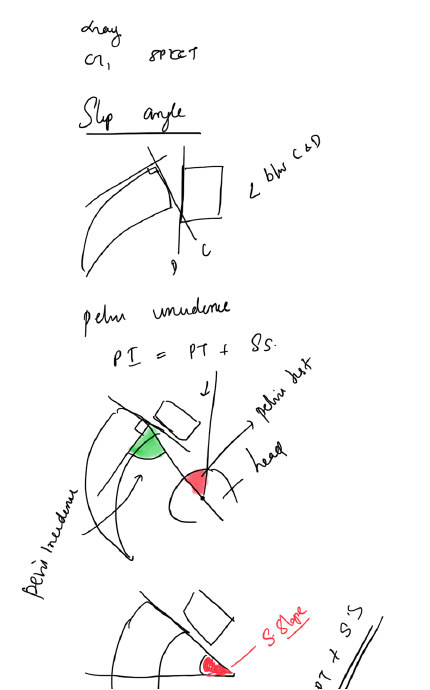
Pelvic incidence, pelvic tilt and sacral slope describe sagittal pelvic morphology and orientation and are important when assessing high-grade slips and sagittal balance.
Treatment
Non-operative
Most low-grade symptomatic cases begin with:
- Activity modification
- Analgesia / NSAIDs where appropriate
- Physiotherapy and core strengthening
Operative
Consider fusion when there is:
- Persistent disabling pain despite adequate non-operative treatment
- Progressive neurological deficit
- Progressive slip or significant deformity
- Cauda equina syndrome
The need for reduction depends on slip grade, sagittal balance and neurological risk.
References
- Orthobullets — Adult Isthmic Spondylolisthesis