Definition
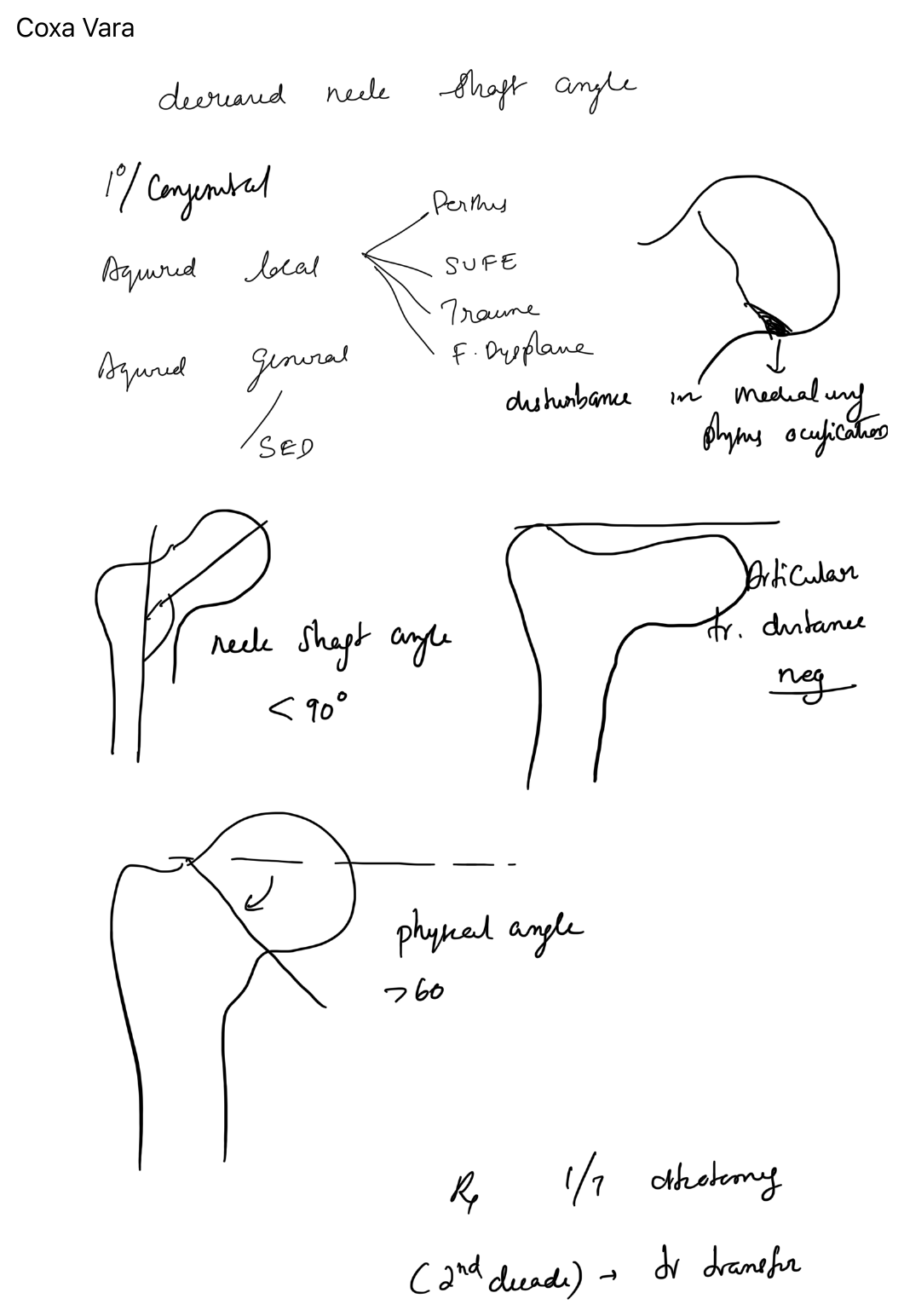
Coxa vara is a reduction in the femoral neck–shaft angle, typically below approximately 120°. Developmental coxa vara is caused by abnormal development of the proximal femoral physis.
Clinical features
- painless limp
- Trendelenburg gait
- reduced abduction and internal rotation
- limb shortening in unilateral disease
Radiographic features
- reduced neck–shaft angle
- vertically oriented proximal femoral physis
- metaphyseal triangular fragment may be seen
The Hilgenreiner epiphyseal angle helps quantify the deformity and predict progression.
Treatment
Observation is appropriate for mild, non-progressive deformity in a young child.
Valgus corrective osteotomy is considered when deformity is severe, progressive or symptomatic. The goal is to reduce the shear force across the proximal femoral physis and restore a more horizontal physeal orientation.
Complications
- recurrence
- limb-length discrepancy
- abductor weakness
- early degenerative change
Diagram