Lateral centre-edge angle
The lateral centre-edge angle of Wiberg assesses superolateral femoral head coverage on an AP pelvis radiograph.
It is measured between:
- a vertical line through the centre of the femoral head, and
- a line from the centre of the femoral head to the lateral edge of the acetabular sourcil.
In the skeletally mature hip:
- > 25° is generally considered normal
- 20-25° is borderline
- < 20° is consistent with acetabular dysplasia
Values must be interpreted with pelvic positioning and the clinical context.
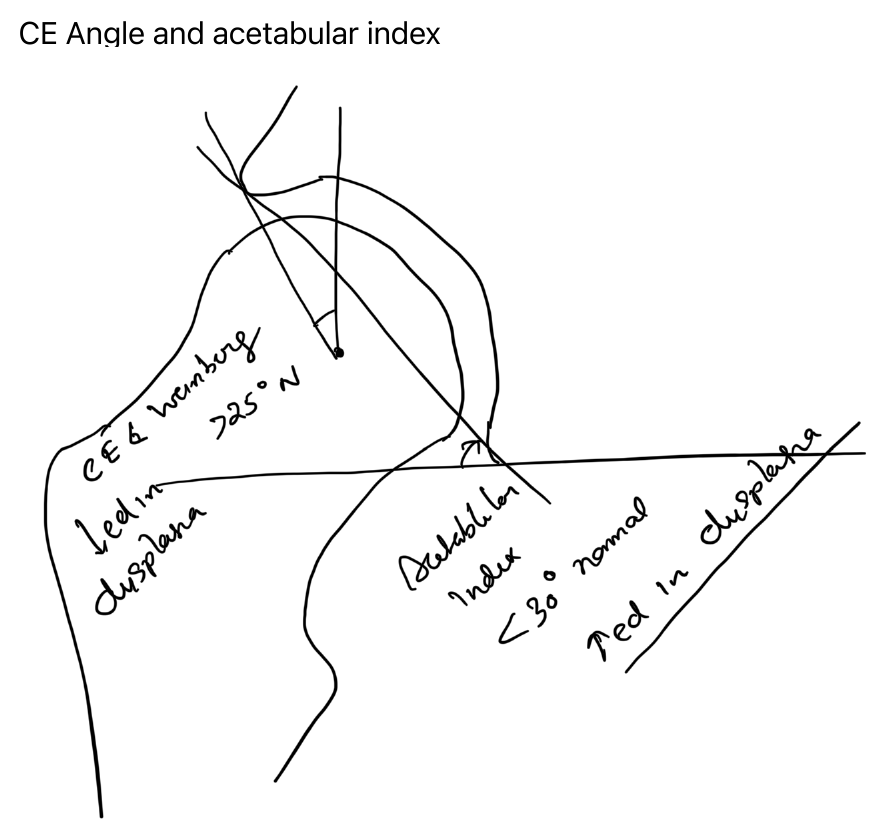
Acetabular index
In children, the acetabular index is measured between Hilgenreiner's line and the acetabular roof. It reflects acetabular development and decreases with age.
In adults, acetabular inclination is more commonly described using the Tönnis angle, measured from a horizontal pelvic reference to the sourcil. Increased inclination supports acetabular dysplasia.
Clinical use
These measurements are useful in the assessment of:
- developmental dysplasia of the hip
- residual acetabular dysplasia
- hip preservation surgery planning
- postoperative assessment after pelvic osteotomy
Pitfalls
- Pelvic tilt and rotation alter the apparent measurements.
- The lateral edge used for the centre-edge angle should be the lateral edge of the weight-bearing sourcil, not an osteophyte.
- Measurements should not be interpreted in isolation from symptoms, examination and other radiographic features.