Functional units
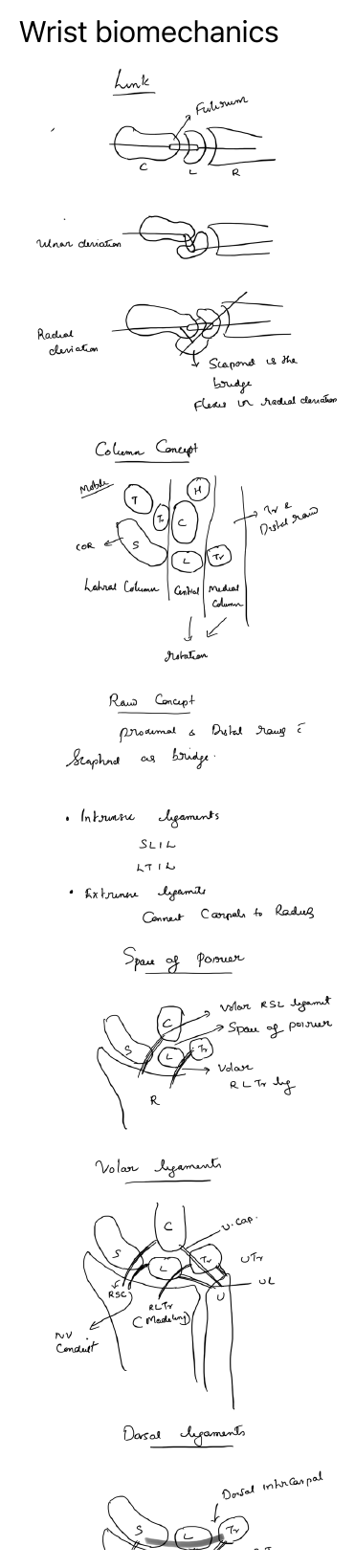
The wrist is formed by the radiocarpal and midcarpal articulations. Motion is shared between these joints rather than occurring at a single centre.
Carpal rows
- proximal row: scaphoid, lunate and triquetrum
- distal row: trapezium, trapezoid, capitate and hamate
The proximal row has no direct tendon insertions and behaves as an intercalated segment between the radius and distal carpal row.
Scaphoid and lunate balance
- the scaphoid tends to flex
- the triquetrum tends to extend
- the lunate is balanced between these forces through the scapholunate and lunotriquetral ligaments
Loss of this balance produces DISI or VISI patterns.
Motion
Flexion and extension are distributed across radiocarpal and midcarpal joints. Radial and ulnar deviation also involve coordinated carpal motion and rotation of the scaphoid.
Load transmission
Most axial load from the hand passes through the radiocarpal joint, with the remainder transmitted through the ulnar side via the TFCC. Load distribution changes with ulnar variance.
Clinical relevance
- scapholunate injury alters carpal kinematics
- positive ulnar variance increases ulnocarpal loading
- carpal instability may progress to degenerative arthritis
Diagram