Anatomy
The triangular fibrocartilage complex (TFCC) stabilises the ulnar side of the wrist and distal radioulnar joint.
Important components include:
- triangular fibrocartilage disc
- dorsal and volar radioulnar ligaments
- ulnolunate and ulnotriquetral ligaments
- ECU subsheath
- meniscus homologue
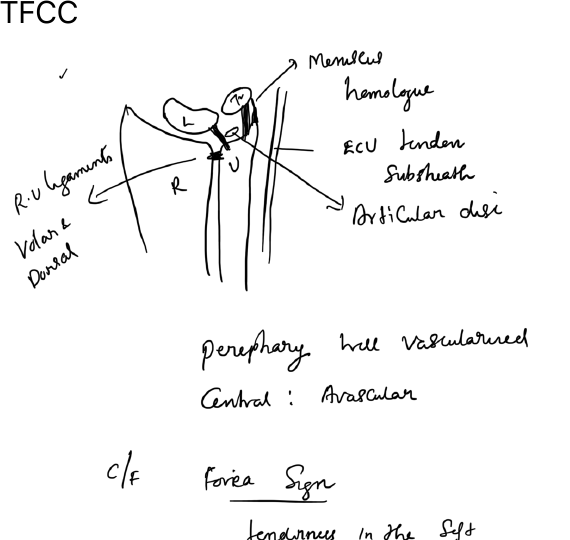
The peripheral TFCC is relatively vascular, while the central portion is largely avascular.
Clinical features
- ulnar-sided wrist pain
- pain with forearm rotation or ulnar deviation
- clicking or mechanical symptoms
- DRUJ instability in some peripheral tears
Fovea sign
Tenderness between the ulnar styloid and flexor carpi ulnaris, near the foveal region, supports TFCC or ulnotriquetral pathology.
Palmer classification
Type 1 - traumatic
- 1A: central perforation
- 1B: ulnar-sided avulsion, with or without ulnar styloid fracture
- 1C: distal avulsion from ulnocarpal ligaments
- 1D: radial-sided avulsion
Type 2 - degenerative
Progressive degenerative lesions associated with ulnocarpal loading, ranging from TFCC wear to chondromalacia and lunotriquetral involvement.
Investigation
- Plain radiographs to assess ulnar variance and associated injury
- MRI or MR arthrography may demonstrate tears
- Wrist arthroscopy is the most accurate method of direct assessment
Treatment
Initial treatment may include activity modification, splintage, anti-inflammatory treatment and therapy.
- Central avascular tears are commonly treated with arthroscopic debridement when symptomatic.
- Peripheral vascular tears may be suitable for repair.
- Associated ulnar impaction may require treatment of positive ulnar variance.