Definition
Swan neck deformity consists of:
- Hyperextension of the PIP joint, and
- Flexion of the DIP joint
It results from imbalance of the extensor mechanism around the PIP joint.
Pathomechanics
A common primary lesion is volar plate laxity, allowing PIP hyperextension. As the PIP hyperextends, the lateral bands migrate dorsally and increase the deforming force.
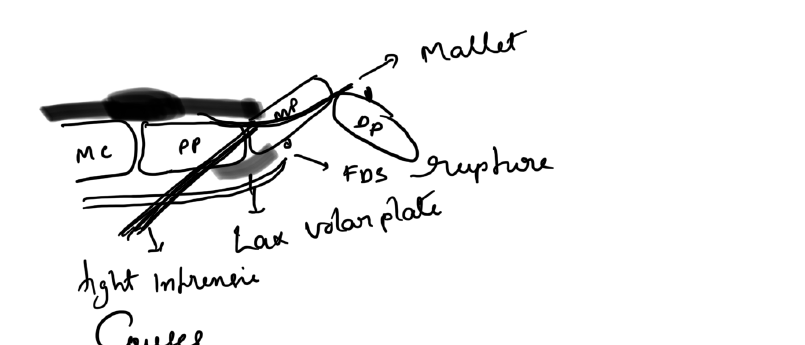
Causes
- Rheumatoid arthritis
- Untreated mallet finger
- FDS disruption
- Intrinsic muscle tightness
- Volar plate insufficiency
- Neuromuscular disorders
Clinical assessment
Assess:
- PIP flexibility
- DIP posture
- Intrinsic tightness
- MCP position
- Underlying inflammatory disease
- Tendon integrity
Nalebuff classification
The classification is based mainly on PIP joint flexibility and the influence of MCP position:
- Type I — flexible in all MCP positions
- Type II — PIP flexion varies with MCP position because of intrinsic tightness
- Type III — stiff PIP joint with limited passive correction
- Type IV — established joint destruction / severe arthrosis
Treatment
Non-operative
- Treat the underlying disease
- PIP extension-block or ring splint in flexible deformity
- Hand therapy
Operative
Procedure depends on the cause and flexibility and may include:
- Volar plate advancement
- FDS tenodesis
- Central slip tenotomy in selected cases
- Intrinsic release
- Arthrodesis or arthroplasty for advanced arthritic deformity
References
- Orthobullets — Swan Neck Deformity