Definitions
Perilunate dislocation occurs when the capitate and the remainder of the carpus dislocate relative to the lunate while the lunate remains seated in the lunate fossa.
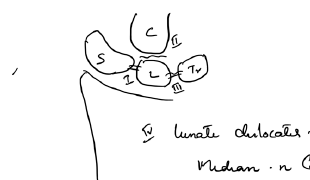
Lunate dislocation is the final stage of progressive perilunar instability, with the lunate displacing from the lunate fossa, usually volarly into the carpal tunnel.
Mechanism
Usually a high-energy injury with the wrist in extension and ulnar deviation. Progressive ligament failure occurs from the radial side of the carpus towards the ulnar side.
Mayfield progression
- Stage I — scapholunate ligament disruption
- Stage II — capitolunate disruption
- Stage III — lunotriquetral disruption: perilunate dislocation
- Stage IV — lunate dislocation from the lunate fossa, usually volar
A lesser-arc injury is predominantly ligamentous. A greater-arc injury passes through adjacent carpal bones and may include a trans-scaphoid perilunate fracture-dislocation.
Clinical features
- Severe wrist pain and swelling
- Marked restriction of movement
- Deformity may be subtle
- Median nerve paraesthesia or acute carpal tunnel syndrome may occur
Median nerve function must be documented before and after reduction.
Radiographs
Obtain good PA and lateral views.
PA view
- Break in Gilula's arcs
- Abnormal overlap of the lunate and capitate
- Scapholunate widening may be present
- Triangular appearance of the lunate: piece-of-pie sign
Lateral view
Normal radius–lunate–capitate collinearity is lost.
- In a perilunate dislocation, the capitate is displaced dorsally relative to the lunate
- In a lunate dislocation, the lunate rotates and displaces volarly
- Volar rotation of the lunate produces the spilled-teacup sign
Acute management
- Urgent reduction and splintage
- Reassess median nerve function after reduction
- Definitive treatment usually requires open reduction, repair of disrupted ligaments and fixation of associated fractures
- Carpal tunnel decompression is added when median nerve compression is present
Closed reduction and casting alone is not reliable definitive treatment for an acute perilunate injury.
Chronic injury
Missed injuries may present with pain, stiffness, weakness and post-traumatic arthritis. Depending on chronicity and cartilage condition, salvage procedures may include:
- Proximal row carpectomy
- Partial wrist fusion
- Total wrist arthrodesis when advanced degenerative change is present
Complications
- Median nerve neuropathy
- Persistent carpal instability
- Loss of grip strength
- Wrist stiffness
- Post-traumatic arthritis
- Chronic pain