Indication
Hunter–Salisbury two-stage reconstruction is used for secondary flexor tendon reconstruction when a satisfactory one-stage tendon graft is unlikely to glide because of severe scarring or loss of the normal tendon sheath and pulley system.
Typical situations include:
- neglected zone II flexor tendon injury
- failed primary repair
- severe tendon-bed scarring
- damaged pulley system requiring reconstruction
Before reconstruction the finger should have a supple passive range of motion and any joint contracture should be corrected.
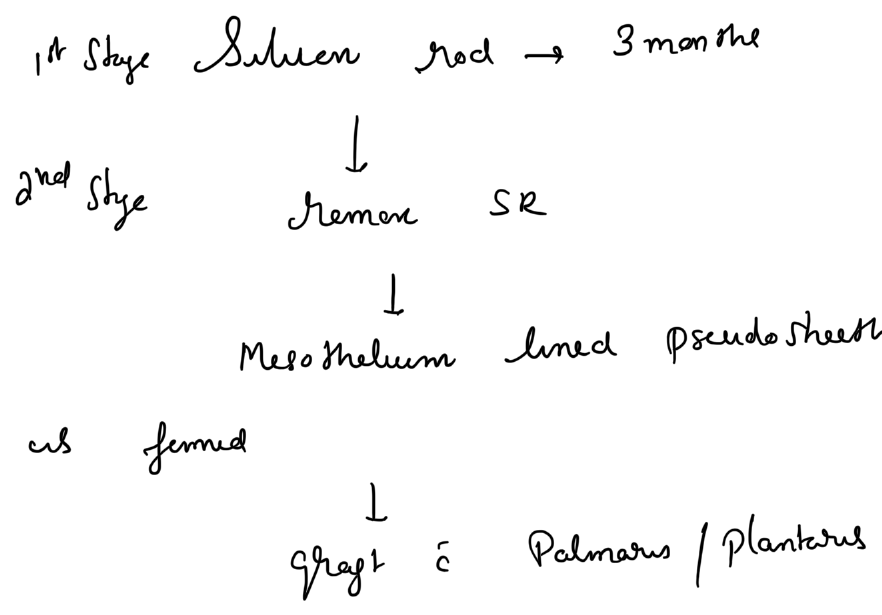
Stage 1
The first stage prepares the tendon bed.
- scarred tendon tissue is excised
- important pulleys, especially A2 and A4, are preserved or reconstructed
- a silicone Hunter rod is inserted along the intended tendon path
- the rod acts as a spacer and promotes formation of a smooth pseudosheath
The rod is usually left in place for several months while the finger is mobilised and passive movement is maintained.
Stage 2
When the pseudosheath has matured:
- the silicone rod is removed
- a tendon graft is passed through the pseudosheath
- commonly used grafts include palmaris longus or plantaris
- the graft is attached distally and proximally with careful tensioning
Principles for success
- full or near-full passive motion before the second stage
- intact or reconstructed pulleys
- supple skin and soft tissues
- appropriate graft tension
- structured postoperative rehabilitation
Complications
- infection
- silicone rod extrusion or migration
- stiffness
- adhesion
- graft rupture
- flexion contracture
- inadequate tendon excursion
References
- Hunter JM, Salisbury RE. Flexor tendon reconstruction in severely damaged hands: a two-stage procedure using a silicone-Dacron reinforced gliding prosthesis prior to tendon grafting.
- Current literature on staged flexor tendon reconstruction using a silicone rod and free tendon graft.