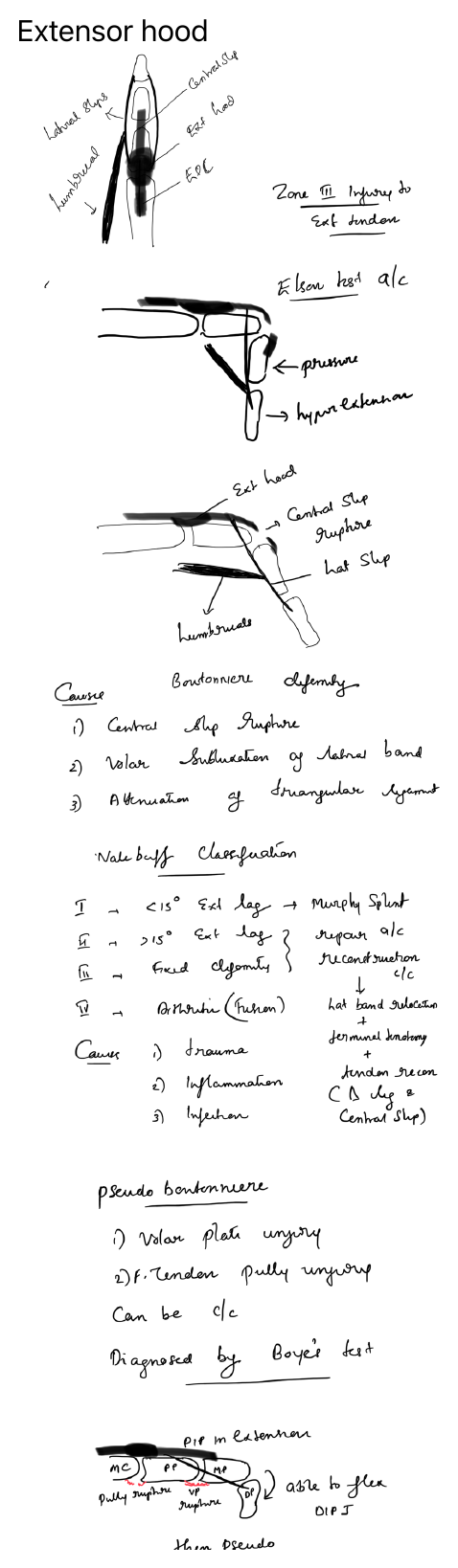
Overview
The extensor mechanism of the finger converts the pull of the extrinsic extensor tendons and intrinsic muscles into coordinated MCP and interphalangeal motion.
Components
At the MCP joint, the extensor tendon is stabilised centrally by the sagittal bands. Distally the extensor mechanism divides into:
- central slip inserting into the base of the middle phalanx
- paired lateral bands that reunite distally to form the terminal tendon inserting into the distal phalanx
The intrinsic muscles contribute through the lateral bands and allow MCP flexion with IP extension.
Important stabilisers
- sagittal bands
- triangular ligament
- transverse retinacular ligament
- oblique retinacular ligament
Clinical correlations
Boutonnière deformity
Central slip failure leads to PIP flexion and secondary DIP hyperextension.
Swan-neck deformity
PIP hyperextension with DIP flexion may result from imbalance of the extensor mechanism.
Sagittal band rupture
May cause extensor tendon subluxation at the MCP joint, classically after direct trauma.
Diagram