Anatomy
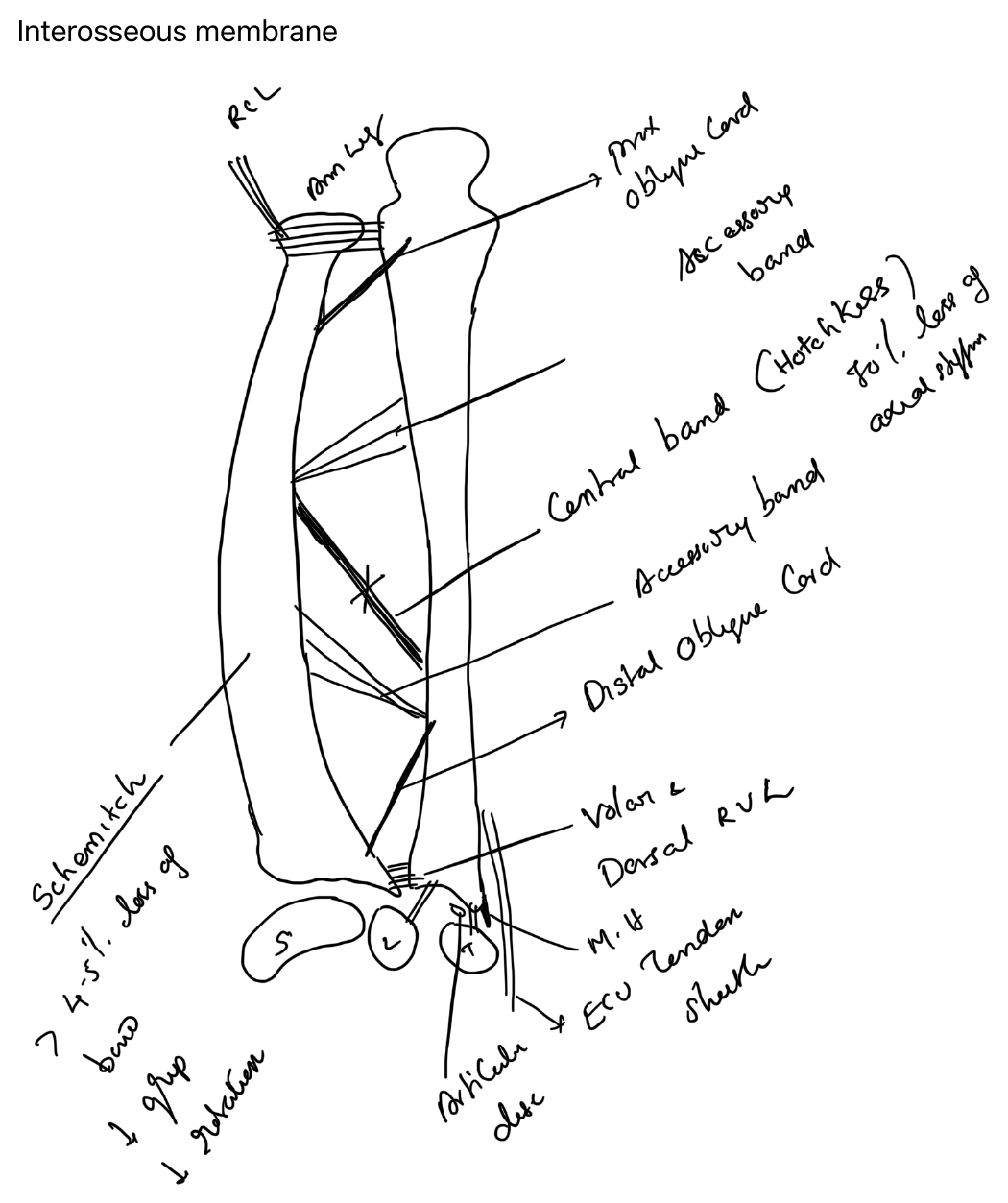
The forearm interosseous membrane links the radius and ulna and contributes to longitudinal stability of the forearm.
The most important stabilising component is the central band, whose fibres run obliquely from the radius proximally to the ulna distally.
Other described components include:
- accessory bands
- proximal oblique cord
- distal oblique bundle
Functions
- transfers load between radius and ulna
- stabilises the forearm during axial loading
- maintains the relationship of the radius and ulna during pronation and supination
- contributes to longitudinal stability of the proximal and distal radioulnar joints
Load transmission
Axial load entering the wrist is transmitted predominantly through the radius. The interosseous membrane transfers part of this load to the ulna before it reaches the elbow.
Essex-Lopresti injury
An Essex-Lopresti injury comprises:
- radial head fracture
- disruption of the interosseous membrane
- injury to the distal radioulnar joint
Failure to recognise the longitudinal instability can lead to proximal migration of the radius, ulnar-positive variance and chronic wrist pain.
Clinical assessment
In a high-energy radial head fracture, examine the wrist and DRUJ and consider forearm instability when there is wrist pain or tenderness along the interosseous membrane.