Definition
Osteosarcoma is a primary malignant bone-forming tumour in which malignant cells produce osteoid.
Epidemiology
- Commonest primary malignant tumour of bone, excluding myeloma
- Most often affects children and adolescents
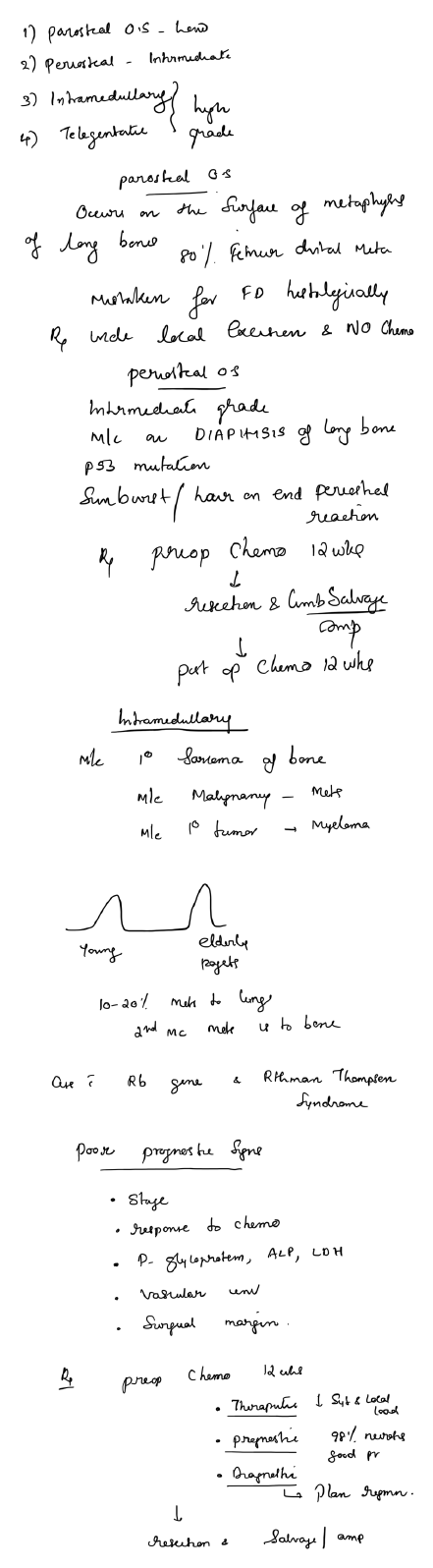
- A second smaller peak may occur in older adults
- Common sites: distal femur, proximal tibia and proximal humerus
Classification
Conventional intramedullary osteosarcoma
The commonest type and usually high grade.
Surface osteosarcomas
- Parosteal osteosarcoma — typically low grade
- Periosteal osteosarcoma — intermediate grade
Other important variants
- Telangiectatic osteosarcoma
- Small-cell and secondary osteosarcoma variants
Clinical features
- Progressive pain
- Swelling or a palpable mass
- Reduced function or limp
- Occasionally pathological fracture
Imaging features
Plain radiographs
- Mixed lytic and sclerotic lesion
- Cortical destruction
- Aggressive periosteal reaction
- Sunburst appearance and Codman triangle may be seen
- Soft-tissue mass may be present
MRI
Best investigation for local staging. It defines intramedullary extent, soft-tissue extension and relation to neurovascular structures.
CT chest
Used to stage for pulmonary metastases.
Diagnosis
Diagnosis is made by biopsy after appropriate imaging and through a specialist bone tumour unit pathway.
Management
- Specialist sarcoma MDT management
- Neoadjuvant chemotherapy for conventional high-grade disease
- Wide resection, usually with limb-salvage surgery where feasible
- Adjuvant chemotherapy
Notes on surface lesions
- Parosteal osteosarcoma is often treated by wide resection alone when low grade.
- Periosteal osteosarcoma may require surgery with or without chemotherapy depending on grade and protocol.
Prognostic factors
- Metastases at presentation
- Histological response to chemotherapy
- Adequacy of surgical margins
- Tumour size and site
- Serum markers such as ALP and LDH may have prognostic value
Metastases
The lungs are the commonest site of metastasis.
Diagram