Basic organisation
Human somatic cells contain 23 pairs of chromosomes. A chromosome contains DNA organised into genes. A gene is a DNA sequence that encodes a functional RNA or protein product.
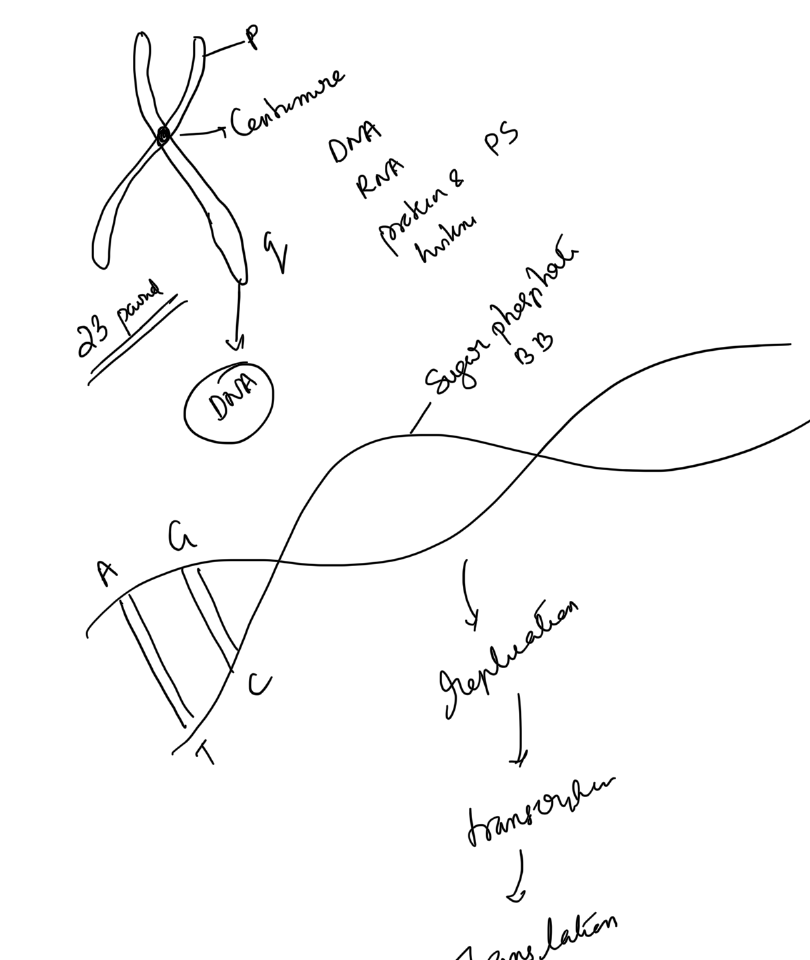
Gene expression
The central sequence is:
DNA -> transcription -> RNA -> translation -> protein
Changes in DNA sequence may alter protein structure, quantity or function.
Mutation types
Important mutation types include:
- point mutation
- deletion
- insertion
- frameshift mutation
- splice-site mutation
- trinucleotide repeat expansion
- chromosomal deletion, duplication or translocation
Patterns of inheritance
Autosomal dominant
- One abnormal allele is sufficient to produce disease.
- Both sexes are affected.
- Male-to-male transmission can occur.
- Examples in orthopaedics include osteogenesis imperfecta and neurofibromatosis type 1.
Autosomal recessive
- Two abnormal alleles are required.
- Parents are commonly unaffected carriers.
- Examples include Gaucher disease and several skeletal dysplasias.
X-linked recessive
- Predominantly affects males.
- Carrier females transmit the abnormal allele to 50% of sons.
- There is no male-to-male transmission.
- Duchenne muscular dystrophy is the classic orthopaedic example.
Penetrance and expressivity
- Penetrance is the proportion of individuals with a pathogenic genotype who show the phenotype.
- Variable expressivity means that severity differs between affected individuals carrying the same pathogenic variant.
Genetic testing
Depending on the disorder, diagnosis may use targeted mutation analysis, gene panels, chromosomal analysis or broader sequencing. Results should be interpreted with clinical findings and family history.