Principles
Deformity analysis begins with a standing full-length radiograph and assessment of mechanical and anatomical axes.
Important questions are:
- Where is the deformity?
- Is it femoral, tibial or combined?
- Is it angular, translational, rotational or length-related?
- Is the adjacent joint orientated normally?
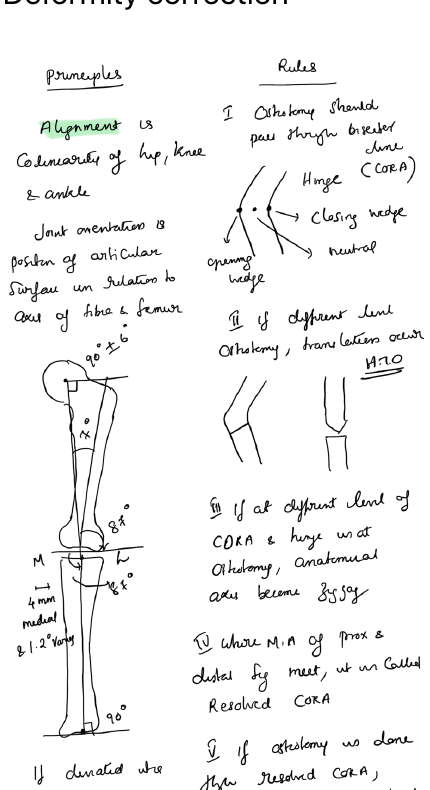
Mechanical axis
The mechanical axis of the lower limb extends from the centre of the femoral head to the centre of the ankle. Its relationship to the knee indicates varus or valgus malalignment.
Joint-orientation angles help localise the deformity to the femur or tibia.
CORA
The centre of rotation of angulation (CORA) is the intersection of the proximal and distal mechanical or anatomical axes of a deformed bone.
- An osteotomy performed at the CORA can correct angulation without creating translation.
- An osteotomy performed away from the CORA requires translation to restore alignment.
Osteotomy options
- Opening-wedge osteotomy
- Closing-wedge osteotomy
- Dome osteotomy
- Translation osteotomy
- Gradual correction with circular external fixation where appropriate
Planning
Planning should define:
- magnitude of angular correction
- level of osteotomy
- hinge position
- desired mechanical axis after correction
- effect on limb length
- any associated rotational or sagittal-plane deformity
Clinical assessment
Document:
- gait
- limb lengths
- knee and ankle alignment
- joint range of motion
- rotational profile
- soft-tissue status
References
- Orthobullets. Adult Limb Deformity & Correction.